No never means no
Refusal as a negotiable starting position
Summary
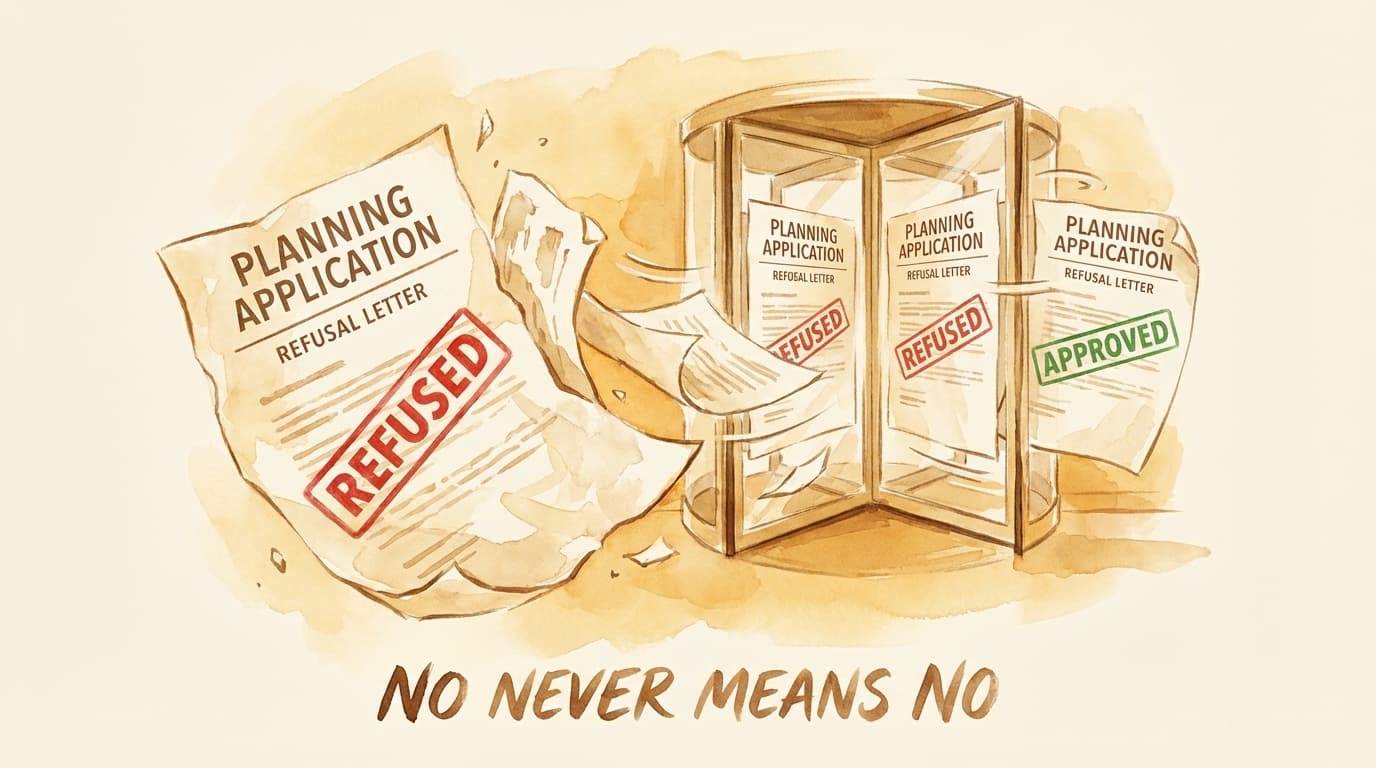
When a planning application is refused in Malta, the story rarely ends there. Refusal is not a verdict — it is a negotiable starting position. Through multiple pathways — reconsideration, appeals, reapplication, and withdraw-and-resubmit — the system systematically converts refusals into approvals. Reconsideration alone overturns 71% of the cases brought before it. Of 17,536 physical sites with at least one refusal, 13,296 (75.8%) eventually obtain approval. The system does not so much refuse development as delay it.
"Same site" here is determined from each case's mapped footprint, not from the address text — see the methodology section for details.
Key findings
Reconsideration: the 71% overturn mechanism
When an applicant requests reconsideration of a planning board refusal, the system overturns its own decisions at an extraordinary rate. Of 9,331 reconsideration cases that reached a final decision:
| Outcome | Cases | % |
|---|---|---|
| Overturned (refusal reversed) | 6,667 | 71.4% |
| Upheld (refusal confirmed) | 2,664 | 28.6% |
An additional 1,077 reconsiderations were granted on permit conditions (modifying rather than reversing), and 444 were withdrawn before decision. This means nearly three-quarters of challenged refusals are overturned—a reversal rate that suggests the original decisions are systematically questioned or that reconsideration applies different standards.
The reconsideration league table: architect-specific overturn rates
Reconsideration is not equally distributed. The architects who file the most reconsiderations tend to win them at the highest rates:
| Architect | Overturned | Upheld | Overturn rate |
|---|---|---|---|
| Perit Mr. Martin Farrugia | 77 | 10 | 82.8% |
| Perit Mr. Michael Falzon | 73 | 17 | 81.1% |
| Perit Mr Anthony Fenech Vella | 92 | 15 | 78.0% |
| Perit Godwin J. Aquilina | 83 | 22 | 73.5% |
| Dr Robert Musumeci LL.D., Perit | 180 | 36 | 72.0% |
| Perit Ronald Azzopardi | 178 | 57 | 71.8% |
| Perit Saviour Micallef | 202 | 63 | 70.6% |
| Perit Mr. Samuel Formosa | 95 | 34 | 70.4% |
| Perit Teddie Busuttil | 76 | 28 | 70.4% |
| Perit Mr. Emanuel Vella | 225 | 91 | 68.2% |
Perit Martin Farrugia tops the table with 82.8%: 77 overturned out of 92 reconsiderations filed, with 10 upheld and the rest withdrawn or pending (rate computed against the full reconsideration roster, matching the table methodology). At volume, Perit Charles Buhagiar filed 488 reconsiderations (the most of any architect), winning 258 of them. This suggests that institutional familiarity with the reconsideration process—or relationships with decision-makers—correlates with overturn rates as high as 83%, raising questions about whether the process is truly merit-based.
The reapplication cycle after refusal
Of all physical sites with at least one refusal:
| Metric | Count |
|---|---|
| Sites with at least one refusal | 17,536 |
| Of those, sites with a subsequent application | 13,842 |
| Of those, sites that eventually got approval | 13,296 |
| Success rate after refusal | 75.8% |
Three-quarters of refused sites eventually get planning approval, typically through a subsequent application at the same parcel. (Earlier text-based counts of this dataset suggested only ~25% — that figure undercounted because it required identical address strings to match, missing same-site cases filed under different building names.)
The withdraw-and-resubmit tactic
Total withdrawals in the database span seven distinct status categories:
| Withdrawal type | Cases |
|---|---|
| Withdrawn by applicant | 7,928 |
| Withdrawn (general) | 818 |
| Withdrawn by Planning Directorate (s.32(6)) | 856 |
| Withdrawn by Planning Directorate | 668 |
| Screening request withdrawn | 304 |
| Reconsideration withdrawn | 444 |
| Application withdrawn (other) | 76 |
| Total withdrawals | ~11,248 |
7,101 sites have both a withdrawn application and a non-withdrawn application at the same parcel — evidence of the withdraw-and-resubmit tactic, where applicants withdraw a problematic application before it receives a formal refusal (which would create a negative precedent on record), then resubmit.
The success rate after withdrawal
| Metric | Count |
|---|---|
| Sites with at least one withdrawal | 8,503 |
| Of those, sites that eventually got approval | 6,644 |
| Success rate after withdrawal | 78.1% |
The success rates after withdrawal (78.1%) and after refusal (75.8%) are nearly identical, suggesting both pathways serve the same function: a cooling-off period before trying again. Both are well above the headline approval rate, meaning that an application that has hit either friction point is more likely to eventually succeed, not less.
The cumulative second-chance system
Combining all the mechanisms available to an applicant whose first attempt fails:
| Mechanism | Cases processed | Estimated reversals |
|---|---|---|
| Reconsideration | 11,532 | 6,667 overturned (71%) |
| Appeals Board / EPRT | 10,595 | Unknown overturn rate |
| Reapplication after refusal | 13,842 sites tried again | ~13,296 eventual approvals (75.8%) |
| Withdraw and resubmit | 7,101 sites | ~6,644 eventual approvals (78.1%) |
About three-quarters of refused sites eventually receive approval through one pathway or another. Combined with the reconsideration mechanism that overturns 71% of cases brought before it, the structural answer to a refusal is rarely "no for good."
The system provides at least four distinct pathways to overcome a "no": reconsideration (71% overturn), appeal, reapplication (75.8% eventual success), and withdraw-and-resubmit (78.1% eventual success). Together, they process tens of thousands of cases and systematically convert refusals into approvals.
Notable cases
All three pairs below have been verified as same-site (the two cases share a mapped footprint, not just an address string):
PA/02717/21 then PA/00731/22 — 6 & 7 Triq San Frangisk, Sliema. Refused in December 2021 for the demolition of existing buildings and construction of 4 duplex units with a ground-floor Class 4B shop. Just over a month later, a near-identical application was filed at the same site — this time proposing ground-floor garages instead of the shop — and was approved in January 2023. The refusal was not a verdict on the site's suitability for development; it was a negotiating position on the ground-floor use.
PA/06524/22 then PA/05754/24 — 23 Triq Dun Gejtanu Mannarino, Birkirkara. A terraced house proposed for demolition and replacement with a Class 4B shop, basement and 3 apartments was refused in February 2024. Two months later, an application for virtually the same development — demolition, shop, basement, 3 apartments — was filed and was approved in June 2025. The descriptions are nearly word-for-word identical, raising the question of what changed between refusal and approval.
PA/07499/21 then PA/02645/25 — 118 Triq Sir Charles Cameron, Gzira. Refused in July 2022 for the demolition of an existing structure (keeping façade) and construction of six residential units. After roughly three years, a new application at the same site proposed demolition above ground floor, retention of the front elevation, a ground/first-floor duplex, apartments on the second and third floors, and a penthouse at receded floor level. Approved January 2026. The strategy: scale back on paper, preserve the façade, and resubmit.
Who uses these pathways?
The withdraw-and-resubmit tactic is disproportionately used by applicants with professional representation. Among the top 20 architects by case volume, the average number of withdrawal cases per architect exceeds 150, suggesting that strategic withdrawal is a standard tool in the professional planning toolkit rather than an exceptional measure.
Professional architects also dominate reconsideration filing: well-connected practitioners achieve overturn rates above 80%, while the system-wide average sits at 71%. This suggests that knowing how to work the system—or having relationships within it—substantially improves outcomes.
Why this matters
A planning system where "no" is followed by four separate mechanisms to achieve "yes" is not a system designed to say no. The 75.8% reapplication success rate and 78.1% withdraw-and-resubmit success rate are not modest at all: they compound with reconsideration (71% overturn rate), appeals, and outright reapplication, all available to the same applicant in sequence. At each stage, the odds tilt toward approval. The cumulative probability that a determined applicant eventually gets permission — through one pathway or another — is substantially higher than the headline refusal rate suggests.
For ordinary citizens, the message is: if you can afford representation, "no" is negotiable. For developers, refusal is not an obstacle — it is a delay. Malta's planning system does not so much refuse development as delay it, and provides a well-defined series of mechanisms for those with resources and expertise to overcome initial refusals.
The implications extend beyond individual cases. If refusals are routinely overturned, then the planning board's initial assessment carries diminished authority. Objectors who invest time and effort in opposing applications — already a tiny minority, as shown elsewhere in this investigation — face a system where even a successful objection is likely to be reversed on reconsideration. This creates a rational disincentive to participate in the planning process at all. The remaining question is whether the 71% overturn rate reflects genuine correction of errors by the original board, or whether reconsideration applies systematically different (and more permissive) standards. The data alone cannot answer this, but the consistency of the rate across thousands of cases suggests a structural pattern rather than case-by-case reassessment.
International context
In Ireland, the national appeals body An Bord Pleanala overturns roughly 33% of appealed decisions — less than half Malta's 71% reconsideration overturn rate. Crucially, Irish appeals involve independent professional assessment by planning inspectors who are separate from the original decision-makers. Malta's reconsideration process, by contrast, routes cases back through the same planning board system, raising questions about whether the review is genuinely independent or simply a second opportunity to reach a different conclusion.
Media sources
- "One out of five of planning permits approved in last 15 years were recommended for refusal" — The Malta Independent, 12 June 2022. Confirms that 21.2% of approved permits (16,029 out of 75,522) between 2006-2021 were initially recommended for refusal, corroborating the systemic pattern where "no" is a negotiable starting position.
- "Plans for Iklin ODZ fuel station again recommended for refusal after series of appeals" — The Malta Independent, 19 May 2025. Documents a case where the same fuel station proposal was recommended for refusal repeatedly across multiple appeals and resubmissions — a concrete example of the refusal-resubmission cycle.
- "Court orders Planning Authority to reconsider refusal of Sliema petrol station upgrade" — MaltaToday, 2025. Confirms the mechanism by which courts order the PA to reconsider refusals, with the court noting the application "has a reasonable prospect of approval" — illustrating how judicial review functions as another pathway to overturn refusals.
Methodology
Each application in the database is mapped as a polygon. "Same site" here means two cases sit on the same patch of ground — their mapped footprints overlap on a ~40m grid. Joining on the address text alone is unreliable: different filings at the same physical parcel often use different address labels (e.g., "Site at, Triq X" then later "Villa Y, Triq X"), so a text-based match understates the persistence pattern by treating same-site cases as separate sites. Reconsideration totals, withdrawal totals, and the architect-level overturn rates are per-case statistics that don't depend on a site key and are unaffected.