Floor by floor
How Malta's skyline crept upward
Summary
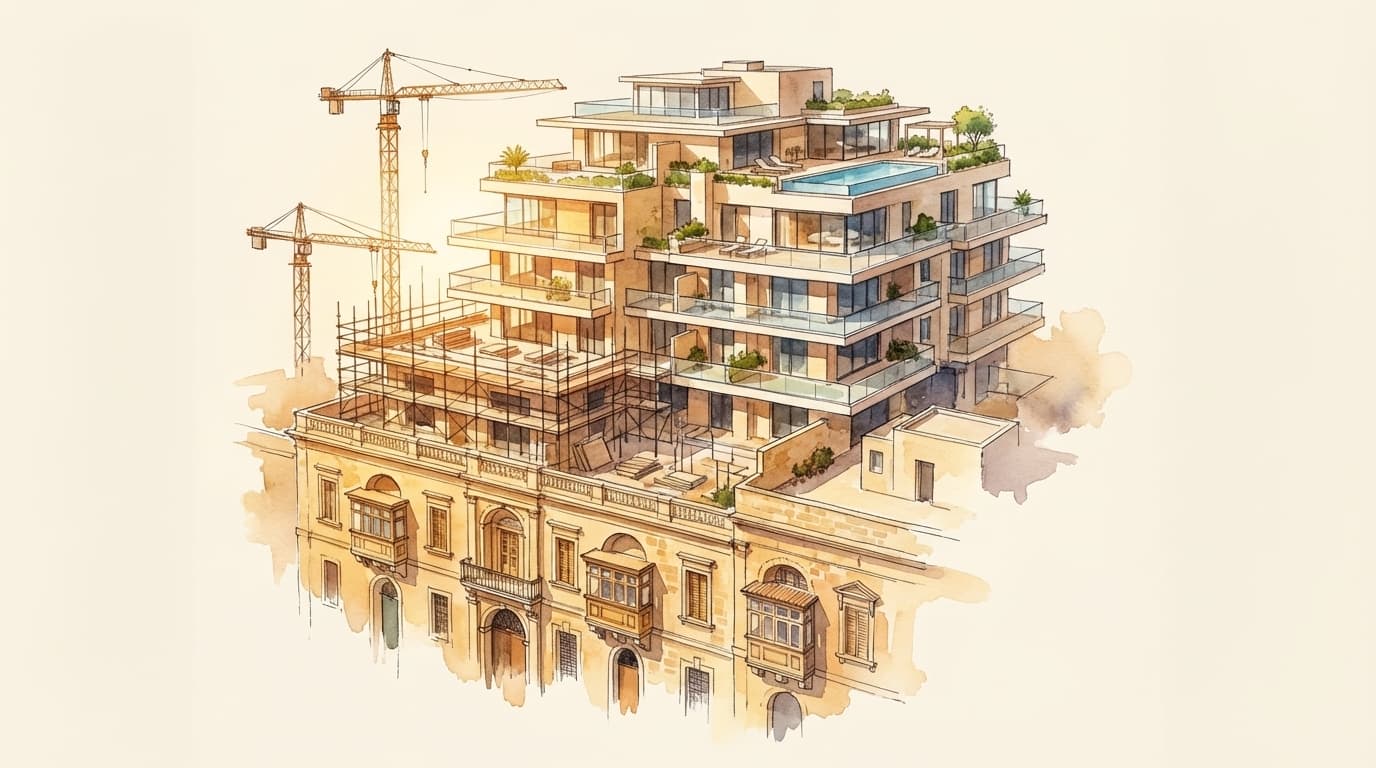
In 2000, only 1.07% of planning applications mentioned a third floor. By 2025, it's 5.17% — a 5x increase. Fourth floor mentions went from 0.21% to 1.95% (9x). Fifth floor from 0.06% to 0.73% (12x). This vertical transformation was enabled by critical policy changes and construction innovations: applications mentioning lifts surged from ~80/year in the 2000s to ~500/year since 2018 (peaking above 600 in 2018 and 2024), and setback floors (receded upper levels) went from virtually zero to nearly 1,000/year. These "enablers" — particularly the 2016 setback floor policy — allowed developers to add extra floors and created Malta's modern skyline. The higher the floor, the bigger the proportional jump. The tallest developments concentrate in a narrow coastal strip: San Pawl il-Baħar, Sliema, Gzira, and Msida.
Key findings
Floor mentions surge (2015→2016):
| Floor level | 2015 | 2016 | Change |
|---|---|---|---|
| 3rd floor | 155 | 410 | 2.6x |
| 4th floor | 58 | 226 | 3.9x |
| 5th floor | 14 | 116 | 8.3x |
| 6th+ floor | 7 | 52 | 7.4x |
Development enablers that made this possible (2015→2017):
| Feature | 2015 | 2016 | 2017 | Growth |
|---|---|---|---|---|
| Lifts | 100 | 140 | 428 | 4.3x in 2 years |
| Setback floors | 49 | 477 | 871 | 17.8x in 2 years |
| Penthouses | 657 | 870 | 952 | 1.4x |
This was not gradual evolution—it was a policy-driven discontinuity. The 2015–2016 height policy changes allowed taller buildings across Malta's development zones. The data shows the immediate cascade: policy enabled lifts and setbacks, which then enabled the floor-count growth.
Setback floors: the policy fingerprint
The most dramatic shift is setback floors—from essentially zero before 2016 to ~800–950/year in steady state. This strongly suggests a policy change around 2015–2016 that allowed or encouraged receded upper floors, fundamentally changing Malta's skyline. Before this policy, buildings had flat tops. After it, setback floors became standard, effectively adding a "bonus floor" to buildings across the island. The full timeline shows the extent of this transformation:
| Year | Lifts | Setback floors | Penthouses | Underground garages | Solar | Total PA |
|---|---|---|---|---|---|---|
| 2005 | 89 | — | — | — | 3 | 8,012 |
| 2010 | 83 | 24 | 563 | 371 | 6 | 5,252 |
| 2015 | 100 | 49 | 657 | 385 | 34 | 4,934 |
| 2016 | 140 | 477 | 870 | 391 | 86 | 7,958 |
| 2017 | 428 | 871 | 952 | 521 | 152 | 11,107 |
| 2018 | 624 | 982 | 942 | 590 | 195 | 11,464 |
| 2019 | 513 | 836 | 730 | 460 | 209 | 9,987 |
| 2020 | 485 | 713 | 596 | 340 | 235 | 8,957 |
| 2021 | 465 | 781 | 599 | 365 | 211 | 9,026 |
| 2022 | 468 | 770 | 660 | 346 | 216 | 8,050 |
| 2023 | 421 | 747 | 652 | 334 | 175 | 7,788 |
| 2024 | 616 | 950 | 712 | 349 | 258 | 8,676 |
| 2025 | 545 | 912 | 716 | 375 | 265 | 8,345 |
Solar panels also boomed, from near zero to 265/year—though still only 3.2% of applications. Underground/basement garages run at 350–590/year, peaking in 2018. Malta is building down as well as up—excavating basements for parking as surface-level space becomes scarce.
Floor mentions over time (absolute numbers)
| Year | 1st floor | 2nd floor | 3rd floor | 4th floor | 5th floor | 6th+ floor |
|---|---|---|---|---|---|---|
| 2000 | 443 | 422 | 72 | 14 | 4 | 2 |
| 2005 | 440 | 460 | 124 | 17 | 1 | 0 |
| 2010 | 389 | 368 | 89 | 23 | 10 | 2 |
| 2016 | 620 | 503 | 410 | 226 | 116 | 52 |
| 2018 | 1,312 | 929 | 590 | 275 | 99 | 42 |
| 2022 | 746 | 533 | 403 | 135 | 66 | 23 |
| 2025 | 724 | 504 | 422 | 159 | 60 | 42 |
Normalized: Malta is building taller, not just more
Even as a percentage of total applications (controlling for the boom in volume), the upward trend is clear:
| Year | % mentioning 3rd floor | % 4th floor | % 5th floor | % 6th+ floor |
|---|---|---|---|---|
| 2000 | 1.07% | 0.21% | 0.06% | 0.03% |
| 2010 | 1.69% | 0.44% | 0.19% | 0.04% |
| 2016 | 4.93% | 2.72% | 1.39% | 0.59% |
| 2018 | 5.27% | 2.46% | 0.89% | 0.35% |
| 2025 | 5.17% | 1.95% | 0.73% | 0.45% |
The proportion of applications involving a third floor or above is now 5x what it was in 2000. Sixth floor and above has gone from virtually zero to nearly half a percent — small-sounding, but representing ~37 tall buildings per year in a tiny country.
Where Malta is growing tallest
Buildings mentioning fifth floor or above, by locality:
| Locality | 5th floor+ apps | % of all apps | Total apps |
|---|---|---|---|
| San Pawl il-Baħar | 399 | 3.82% | 10,438 |
| Sliema | 158 | 1.97% | 8,011 |
| Msida | 102 | 2.16% | 4,722 |
| St Julians | 97 | 1.56% | 6,235 |
| Gzira | 89 | 2.52% | 3,534 |
| Valletta | 41 | 0.72% | 5,672 |
| Ta' Xbiex | 17 | 2.10% | 810 |
San Pawl il-Baħar leads overwhelmingly with 399 tall-building applications — nearly 4% of all its cases. Gzira has the second-highest concentration at 2.52%. These are the towns where Malta's skyline is being most dramatically reshaped.
By contrast, traditional towns like Mosta (0.08%), Birkirkara (0.07%), and even Ħamrun (0.15%) remain largely low-rise.
The growth multipliers
The higher the floor, the bigger the proportional change since 2000:
| Floor | 2000 % | 2025 % | Multiplier |
|---|---|---|---|
| 3rd | 1.07% | 5.17% | 4.8x |
| 4th | 0.21% | 1.95% | 9.3x |
| 5th | 0.06% | 0.73% | 12.2x |
| 6th+ | 0.03% | 0.45% | 15x |
Each floor level has grown proportionally more than the one below it. Malta isn't just building a bit taller — it's systematically pushing its height envelope, with the biggest changes at the top.
Notable cases
PA/05714/18 — Triq Sant' Andrija, St Julian's. Total demolition of an existing building to construct a ten-storey hotel with kitchen at basement, restaurant at ground floor, and a pool deck at the tenth floor. The case officer recommended refusal. The board approved it in June 2019. A single building replaced by a tower nearly three times the traditional Maltese height limit, in the heart of St Julian's — with professional advice overruled.
PA/01815/23 — Neptune Court, St Julian's. A renewal of a 2018 permit to demolish existing structures at the seventh floor and build upward: two apartments at the 7th floor, two at the 8th, two receded at the 9th, and the original apartment reinstated at a receded 10th floor. Approved September 2023. The case shows how buildings grow incrementally — each application adding another floor or two to an already-tall structure.
PA/02610/15 — Triq il-Qbajjar, Marsalforn, Gozo. An amendment to add an eleventh floor to an already-approved development. The applicant argued the additional floor maintained the same total square metres — just redistributed upward. Approved October 2016, the same year the setback floor policy transformed Malta's height landscape. Even Gozo, traditionally lower-rise than Malta, is not immune to the vertical push.
Why this matters
Malta has traditionally been a low-rise Mediterranean landscape. The data shows a clear, policy-driven transformation toward taller buildings, concentrated in coastal towns. The 2016 inflection point — visible as a sudden 3–8x jump in upper-floor mentions — marks the moment Malta's height policy fundamentally changed. Behind these taller buildings stand the enablers: the lift boom (80→600+/year), the setback floor explosion (0→1,000/year), and policies that made basement garages standard. Together, these technologies and regulatory shifts created the economic conditions for vertical development. Malta's skyline is being rewritten floor by floor, enabled lift by lift, in a single generation.
The transformation raises pressing questions about infrastructure capacity. Each additional floor multiplies demand on roads, water, electricity, and sewage systems that were designed for a low-rise island. San Pawl il-Baħar — with 399 tall-building applications, nearly 4% of all its cases — is already notorious for traffic congestion, water pressure issues, and strained public services. Are infrastructure investments keeping pace with the vertical growth the planning system is enabling?
The concentration in a narrow coastal strip (San Pawl il-Baħar, Sliema, Gzira, Msida) also raises questions about shadow impact, wind tunnelling, and loss of sea views for existing residents — none of which are systematically assessed in individual applications. A cumulative impact assessment of height increases across these towns has never been published. Until it is, each tall-building approval is made in isolation, without understanding the collective effect on the townscape.
International context
England's Green Belt and conservation area policies impose hard limits on building height, with local plans specifying maximum storeys for each zone. The setback floor — Malta's "bonus floor" mechanism — has no direct English equivalent; receded upper storeys in England are assessed against the same height policies as any other floor and do not receive preferential treatment. In London, where tall buildings are most concentrated, the Greater London Authority requires a formal "Tall Building Assessment" for any structure significantly taller than its surroundings, including analysis of wind, shadow, and heritage impact. Malta's 2016 policy change enabled a comparable densification without comparable safeguards.
Media sources
- "New heights policy paves way for property boom" — MaltaToday, 9 March 2016. Explains how the DC15 policy converted floor limits into metre-based heights, allowing developers to add floors without amending local plans — directly corroborating the 2015–2016 inflection point visible in the data.
- "PA starts reform of building heights policy with vague objectives" — MaltaToday, 19 February 2024. Confirms the 2015 heights policy enabled five-storey developments across most urban areas and that PA boards have "frequently approved five-storey projects" in three-floor zones.
- "Planning reform gives Planning Authority power to change building height limits" — MaltaToday, 30 July 2025. Reports that the PA Executive Committee can now independently change height limitations, further consolidating the vertical development trend.
- "Controversial DC15 building height limits could be formalised in local plans" — Times of Malta, 19 February 2024. Confirms the DC15 policy published in 2015 converted height limits from floors to metres, enabling developers to squeeze more floors -- described as "a single table that completely changed Malta's built landscape."
- "Developers are rushing to build higher hotels before rules change, Momentum says" — Times of Malta, 15 November 2025. Reports a hotel height incentive policy allowing hotels to rise two storeys above local plan limits, now being scrapped after a decade -- corroborating the policy-driven vertical expansion documented in this discovery.