The ODZ foot in the door
How reservoirs become villas
Summary
Outside Development Zone (ODZ) land in Malta is theoretically protected from development. In practice, 19,707 applications have been approved in ODZ since 1993 — and the rate is accelerating. The data reveals a systematic pattern: a landowner gets approval for something small and unobjectionable — a water reservoir, a rubble wall, an agricultural store — and then uses the established footprint as a springboard for bigger applications. Of 2,556 ODZ sites that started with an approved reservoir, 27.5% (702 sites) later got something else approved at the same site. At least 185 sites show a clear escalation from reservoir to a dwelling. Approved ODZ reservoirs grew from 19/year (1998) to 304/year (2020) — a 16x increase — and approved ODZ dwellings grew from 51/year (1999) to 256/year (2020), a 5x increase.
"Same site" here is determined from each case's mapped footprint, not from the address text — see the methodology section for details. ODZ commission statistics are drawn from board hearing records in the PA database.
The escalation pattern
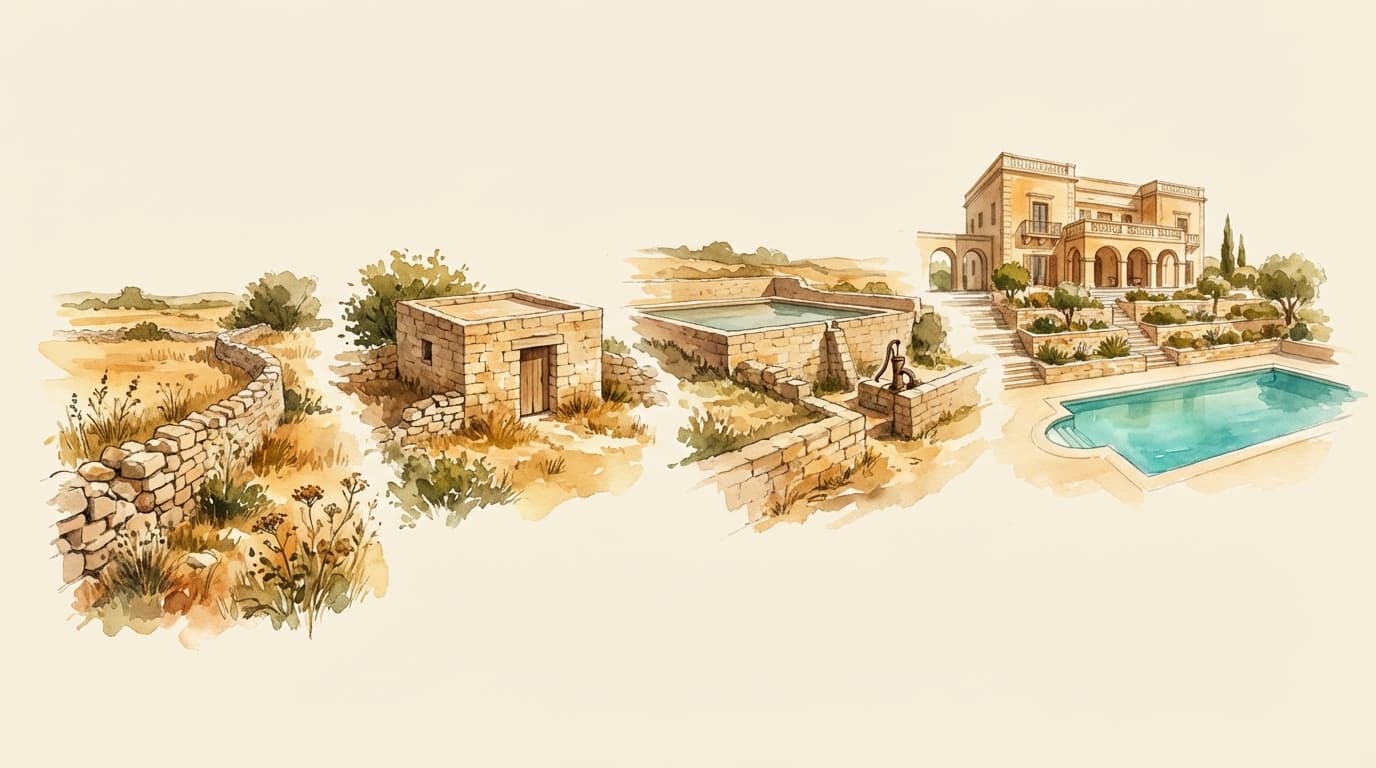
The typical ODZ escalation chain follows a recognisable sequence:
Reservoir → Agricultural store → Rubble wall "repairs" → Dwelling → Pool → Apartments
   (1)           (2)                  (3)                  (4)      (5)      (6)
Each step is individually defensible. A reservoir is agricultural infrastructure. A store holds tools. Rubble wall maintenance preserves heritage. But cumulatively, the site transforms from open countryside into a residential compound — all Outside Development Zone.
The numbers
Of 3,923 ODZ sites with 2+ approved applications, the first approved application was:
| First application type | Sites |
|---|---|
| Other | 1,916 |
| Dwelling (already started big) | 883 |
| Reservoir | 474 |
| Store / pump room | 381 |
| Pool | 144 |
| Rubble wall | 125 |
474 ODZ sites began their planning history with a reservoir. Another 381 started with a store and 125 with a rubble wall — together, 980 sites where the first approved development was minor agricultural infrastructure.
From reservoir to something more
Of 2,556 ODZ sites with an approved reservoir (and no dwelling at the same site):
- 702 (27.5%) later got a different type of development approved at the same site
- 185 sites show a direct escalation from a reservoir-only first approval to an approved dwelling
Of 2,259 ODZ sites with an approved agricultural store / pump room:
- 148 (6.6%) later had a dwelling approved at the same site
The acceleration
ODZ approvals have more than doubled over three decades. Period totals are by filing year and sum to the 19,707 headline. Sub-category counts are not exclusive — a single application that mentions both a reservoir and a dwelling is counted in both columns.
| Period | Total ODZ approved | Reservoirs | Rubble walls | Dwellings/houses | Pools | Apartments |
|---|---|---|---|---|---|---|
| 1993–2004 | 4,209 | 317 | 99 | 697 | 285 | 26 |
| 2005–2014 | 4,844 | 510 | 253 | 891 | 366 | 84 |
| 2015–2026 | 10,654 | 2,463 | 1,680 | 2,002 | 1,116 | 200 |
The 2015–2026 period shows explosive growth across every category. Reservoirs went from 510 to 2,463 (4.8x). Rubble walls from 253 to 1,680 (6.6x). Pools from 366 to 1,116 (3.0x). Even apartments in ODZ more than doubled from 84 to 200.
Year-by-year ODZ approvals
| Year | Total | Reservoirs | Dwellings/houses | Pools |
|---|---|---|---|---|
| 1998 | 488 | 19 | 63 | 18 |
| 1999 | 416 | 18 | 51 | 15 |
| 2003 | 712 | 66 | 124 | 64 |
| 2007 | 668 | 73 | 159 | 52 |
| 2011 | 129 | 15 | 23 | 9 |
| 2015 | 581 | 104 | 109 | 71 |
| 2019 | 1,062 | 201 | 216 | 141 |
| 2020 | 1,268 | 304 | 256 | 141 |
| 2021 | 1,219 | 322 | 222 | 134 |
| 2024 | 999 | 266 | 147 | 71 |
2020–2021 was the peak: over 1,200 ODZ approvals per year, with 300+ reservoirs and 220+ dwellings approved annually. The reservoir count is the leading indicator — it peaks before dwellings, suggesting sites are being prepared. The 2011 trough reflects the MEPA-to-PA transition that disrupted application intake; surrounding years are 4–7x higher.
Case studies
The escalation pattern is real, but only when "same site" is established from each application's mapped footprint, not from the address text. Each case study below pulls cases that sit on the same patch of ground, share an applicant, and cross-reference earlier permits in their own descriptions.
Ciromblu Bio Indigenous Farm, Delimara: bird traps → tourism attraction
The clearest end-to-end example in the modern data. A single ODZ site at Kalanka t-Tawwalija, Marsaxlokk; applicant Mr Kenneth Abela; cumulative chain 2016–2025:
| Filed | Case | What | Result |
|---|---|---|---|
| 2016 | PA/04951/16 | Remove bird traps; sanction pre-1994 structures as agricultural implement stores; construct underground reservoir, pump room, storage tanks, install wind-driven pump | Approved (2017) |
| 2017 | PA/03653/17 | Install greenhouses on arable land | Approved (2017) |
| 2017 | PA/03698/17 | Relocate consolidated agricultural stores per PA/04951/16 | Approved (2017) |
| 2018 | PA/07104/18 | Breeding farm: Maltese goats, black Maltese chickens, bee apiary | Approved (2019) |
| 2020 | PA/03307/20 | Farm retail outlet for on-site produce (cites PA/04951/16, PA/03653/17, PA/07104/18) | Approved (2020) |
| 2022 | PA/03910/22 | Construction and alterations to existing agricultural implement store including a farmer dwelling to dairy farm holding, plus organic farming store | Approved (2023) |
| 2025 | PA/03988/25 | Convert vernacular building to visitor attraction hub for rural tourism; sanction additions to dairy, retail outlet and farmer's residence; addition of pool to farmer's residence (cross-references PA/04951/16, PA/03653/17, PA/07104/18, PA/03307/20, PA/03910/22) | Approved (2026) |
From bird traps and agricultural stores in 2016 to a farmer dwelling, dairy operation, retail outlet, swimming pool and tourism hub by 2026. Each step references the previous permits explicitly; same applicant throughout; the mapped footprints all sit on one site.
Ras il-Wied, Wardija: reservoir → dwelling rebuild → pool
A second-stage escalation around an existing rural dwelling. Applicant Mr Charles Gauci, on Triq Ras il-Wardija:
| Filed | Case | What | Result |
|---|---|---|---|
| 2005 | PA/00364/05 | Construction of reservoir and deposit of soil on agricultural land | Approved (2006) |
| 2005 | PA/03361/05 | Sanction changes to existing dwelling covered by P.A.P.B. permit | Approved (2005, case officer recommended Refuse) |
| 2006 | PA/04408/06 | Roof the reservoir for safety, add pump room | Approved (2007) |
| 2006 | PA/07189/06 | Demolish existing dwelling approved by PA/03361/05; reconstruct on same footprint | Approved (2007) |
| 2010 | PA/01276/10 | Construct swimming pool; amend PA/07189/06 (cross-reference) | Approved (2011) |
A pre-existing rural dwelling was rebuilt and expanded with a reservoir, pump room and pool over five years. The 2005 dwelling-sanctioning was approved despite a refuse recommendation from the case officer.
The Meadows, Bidnija: farmhouse → reservoir → pool → stable
Accumulation pattern at an existing farmhouse. Applicant Ms Maria Psaila (one earlier case at the same site filed by Mario Psaila); Triq tal-Hzejjen:
| Filed | Case | What | Result |
|---|---|---|---|
| 2007 | PA/06755/07 | Internal/external alterations to existing farmhouse | Approved (2008) |
| 2008 | PA/03769/08 | Pool, balance tank, pumproom, irrigation reservoir and tool store under existing private road | Approved (2010) |
| 2011 | PA/03985/15 | Regularise additions to approved residence | Approved (2016) |
| 2017 | PA/09869/17 | Opramorta, photovoltaic panels, light-weight screening | Approved (2018) |
| 2018 | PA/07501/18 | Natural pond to replace reservoir approved in PA/09869/17 (cross-reference) | Approved (2019) |
| 2020 | PA/00451/21 | Sanction greenhouse and lightweight structure; construct stable | Approved (2022) |
In 2007 the site was an existing farmhouse with no pool. By 2022 it had a pool, a reservoir later reframed as a "natural pond", photovoltaic panels, a stable, and a regularised footprint expansion — all in ODZ.
The mechanism
Why does this work? Several factors enable the escalation:
-
Legitimate first step: Reservoirs, rubble walls, and agricultural stores are genuinely needed for farming. Refusing them seems unreasonable.
-
Established footprint: Once a structure exists on ODZ land — even a small one — future applications reference it. "Alterations to existing building" is easier to approve than "new building on empty land."
-
Sanctioning normalises: Many applications sanction work "as built" — the structure already exists. Refusing means ordering demolition, which is politically and legally difficult.
-
Incremental approvals: Each step is a small change from the previous approved state. No single application transforms a field into a villa — but 4–5 applications over 10 years do.
-
Different applicant names: Some sites show ownership changes between applications. The new owner inherits the approved footprint and applies for "alterations" that substantially expand it.
-
815 ODZ sites have 4+ approved applications — averaging 5.5 approvals each. These are not one-off rural buildings; they are sustained development campaigns on protected land.
Key findings
Notable cases
PA/04951/16 → PA/03988/25 — Kalanka t-Tawwalija, Marsaxlokk (Ciromblu farm). In 2016, bird traps were removed and pre-1994 structures sanctioned as agricultural implement stores with an underground reservoir, pump room and storage tanks. Nine years later, on the same site and by the same applicant, the PA approved a "visitor attraction hub for rural tourism" with sanctioned additions to the dairy farm, the retail outlet, and the farmer's residence — including the addition of a swimming pool. Each later permit cross-references the earlier ones.
PA/00364/05 → PA/01276/10 — Ras il-Wied, Wardija. In January 2005, a reservoir and soil deposit on agricultural land was approved. Within five years, the same applicant rebuilt the existing dwelling, added a roofed reservoir, a pump room, and finally a swimming pool, with each permit amending the previous one. The cluster represents a textbook accumulation around a pre-existing rural dwelling.
Why this matters
Malta's ODZ is meant to protect the last remaining open countryside on one of Europe's most densely built islands. The "foot in the door" pattern shows how the planning system's case-by-case approach systematically fails to prevent cumulative development. No single reservoir application is unreasonable. But 300 approved reservoirs per year, many of which are the first step toward dwellings and pools, represent a slow-motion transformation of the countryside. The data shows this isn't slowing down — it's accelerating.
International context
In England, planning applications for "inappropriate development" in the Green Belt — the closest equivalent to Malta's ODZ — are approved only around 20% of the time. Malta's overall ODZ approval rate is 71% (19,707 grants vs 8,027 refusals) — more than three times higher. England's National Planning Policy Framework treats Green Belt as a near-absolute constraint, requiring "very special circumstances" to justify development. Malta's ODZ framework uses similar language but the data shows the outcome is radically different. (At ODZ commission hearings specifically, the approval rate climbs to 91% — see the commission section below.)
What this means going forward
The reservoir-to-dwelling pipeline raises fundamental questions about whether ODZ protection is a genuine land-use constraint or a speed bump that adds paperwork but not protection. If 27.5% of reservoir sites eventually get something else approved at the same site, the planning system is not preventing development in the countryside — it is phasing it. The 2020–2021 peak of 300+ reservoir approvals per year suggests a wave of dwelling applications will follow in the late 2020s.
The most urgent policy question is whether the planning system should assess ODZ applications in isolation or consider cumulative development at the same address. Currently, each application is judged on its own merits, meaning the commission that approves a reservoir never formally considers whether it is the first step in a residential development. A simple reform — requiring disclosure of all previous approvals at the same address and flagging sites with escalation patterns — could break the cycle without blocking legitimate agricultural infrastructure. The pattern documented here connects directly to "Two-minute justice" ("Two-Minute Justice"): many of these ODZ cases are decided by a three-person commission in minutes, with virtually no dissent.
The ODZ Commission: three people, no dissent
The board minutes reveal the machinery behind the numbers. Since 2021, ODZ applications are heard by a dedicated ODZ Planning Commission — a panel of just 3 members.
The panel
One man dominates: Mr Martin Camilleri has chaired 6,789 ODZ hearings — more than all other chairs combined. The two regular members are Mr Frank Ivan Caruana Catania (appears in 7,371 hearings as member or voter) and Perit Joel Fenech (4,660 hearings); they sit together on 3,809 hearings. Mr Carmel Caruana rotates in for 1,222 hearings.
Approval rates by type at ODZ commission
Cases are bucketed by descriptionOfWorks keyword in priority order (reservoir → rubble wall → apartment → pool → dwelling → other) so each hearing is counted once. Hearings here count Approved+Refused only (deferrals excluded).
| Application type | Hearings | Approved | Unanimous | Refused | Approval % |
|---|---|---|---|---|---|
| Reservoir | 658 | 599 | 591 (98.7%) | 59 | 91.0% |
| Dwelling | 592 | 564 | 547 (97.0%) | 28 | 95.3% |
| Pool | 384 | 370 | 366 (98.9%) | 14 | 96.4% |
| Rubble wall | 206 | 185 | 179 (96.8%) | 21 | 89.8% |
| Apartment | 139 | 128 | 123 (96.1%) | 11 | 92.1% |
| Other | 1,987 | 1,808 | 1,769 (97.8%) | 179 | 91.0% |
Even dwellings — full houses on protected land — are approved unanimously 97% of the time, and pools nearly 99%. Across all six rows, refusal is rare (under 11% in every category).
Year-by-year ODZ commission decisions
| Year | Decisions | Approved | Refused | Unanimous approvals | Contested approvals |
|---|---|---|---|---|---|
| 2021 | 1,194 | 587 (91%) | 58 | 572 | 1 |
| 2022 | 1,477 | 701 (91%) | 69 | 683 | 2 |
| 2023 | 782 | 271 (89%) | 33 | 264 | 2 |
| 2024 | 1,508 | 770 (95%) | 42 | 752 | 4 |
| 2025 | 2,342 | 1,100 (92%) | 92 | 1,085 | 6 |
| 2026 (to May) | 509 | 225 (93%) | 18 | 219 | 1 |
Across 7,812 decisions, only 16 approvals saw any dissent — that's 0.2%. The ODZ commission is, in practice, a unanimous approval machine.
How hearings work
The board minutes with timestamps reveal the pace. A typical ODZ commission session processes cases every 10–20 minutes. Common justification patterns:
- "The latest drawings are considered to address the reasons for refusal." — The case officer recommends refusal (the "reasons for refusal" or RFR), but the architect amends drawings and the commission overrides the recommendation. This is the standard flow.
- "NTC 3.1 / 3.2 applies" — Standard conditions added mechanically.
- "Perit present / Time: 10:17AM" — The hearing log. Cases are dispatched rapidly.
The PA/03361/05 dwelling-sanctioning at Ras il-Wied (case study above) is a documented example of the override pattern: the case officer recommended refusal; the commission granted permission anyway, four months later.
Media sources
- "An unstoppable ODZ landgrab" — MaltaToday, 25 January 2018. Confirms two-thirds of ODZ residential applications were approved between 2013-2017, and that ODZ applications tripled over the same period.
- "When ODZ is not ODZ: How a new planning policy will change the Maltese countryside" — MaltaToday, 3 October 2014. Documents the 2014 rural policy that enabled countryside ruins to become villas, allowing non-farmers to convert pre-1978 structures into residences with pools and stores.
- "The continued take-up of ODZ land" — The Malta Independent, 1 April 2024. Editorial confirming the ongoing erosion of ODZ protections and the persistent conversion of agricultural land to residential use.
- "When ODZ is not strictly ODZ" — Times of Malta, 17 July 2020. Documents how "dilapidated buildings" in pristine countryside have been turned into villas, and livestock pens converted into dwellings -- directly corroborating the reservoir-to-villa escalation pattern.
- "Gozo developer Portelli renounces Qala permit following outrage" — Times of Malta, 2 November 2019. Portelli renounced a permit to convert a small countryside room into a villa in Qala after public outrage, illustrating the ODZ escalation pattern of establishing a footprint then seeking expansion.
Methodology
Each application in the database is mapped as a polygon. "Same site" here means two cases sit on the same patch of ground — their mapped footprints overlap on a ~40m grid. Joining on the address text alone is unreliable: many entries default to a road-level label ("Site at, Triq X, Town") that is reused across distinct buildings on the same street, which inflates apparent single-site totals. Period and year totals are by filing year, which sums to the headline 19,707 ODZ approvals.