Overriding the experts
When heritage and nature say no, planning says yes
Summary
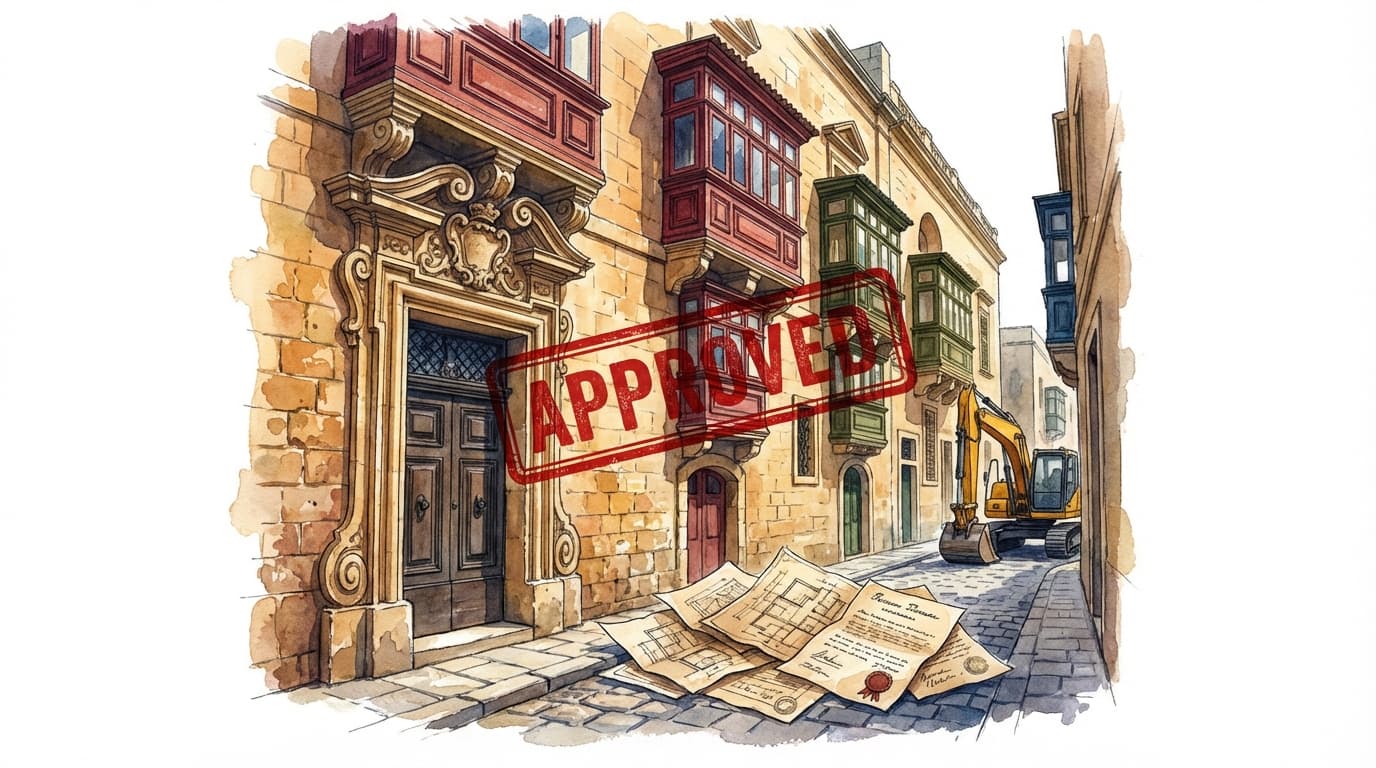
Malta's planning system includes two expert advisory panels: CHAC (Cultural Heritage Advisory Committee) and NHAC (Natural Heritage Advisory Committee). Between 2010 and 2016, they reviewed thousands of applications and flagged 319 with formal objections — cases where experts said the proposed development would harm Malta's cultural or natural heritage. The planning authority overrode those objections 63% of the time, approving developments near World Heritage sites, in ecological protection zones, and involving demolition of traditional buildings that experts said should be preserved.
Heritage Advisory Committee opinion records and matching board decisions are both drawn from the PA database. See methodology for coverage details.
The numbers
| Panel | Objections | Overridden (approved anyway) | Upheld (refused) | Override rate |
|---|---|---|---|---|
| CHAC (Cultural Heritage) | 124 | 85 | 27 | 68.5% |
| NHAC (Natural Heritage) | 195 | 115 | 59 | 59.0% |
| Combined | 319 | 200 | 86 | 62.7% |
When heritage experts formally objected to a development, the planning authority approved it anyway nearly two-thirds of the time. Cultural heritage objections were overridden more often (68.5%) than natural heritage ones (59%).
For comparison, when neither panel objected, cases were still approved at high rates — but objections were meant to be a meaningful check. They aren't.
The rubber stamp in reverse
When the panels found no objection (the vast majority of cases), approval rates were:
- CHAC no objection → 94.3% approved (2,151 of 2,328 decided)
- NHAC no objection → 78.1% approved (856 of 1,096 decided)
So a CHAC objection only drops the approval rate from 94% to 69%. The objection barely moves the needle.
What gets overridden
Cultural heritage: demolishing traditional Malta
The CHAC objections that were overridden tell a story of Malta's built heritage being systematically erased:
Demolition of traditional houses:
-
PA/00517/16 (Birkirkara) — "The Panel objects to the proposed demolition as the property is of typical design and construction of the era. Furthermore it forms one of an uninterrupted series of Maltese traditional houses which should be preserved." → Approved. Demolished for 4 units + garages.
-
PA/01223/15 (Birżebbuġa) — "The Panel having noted the existing construction considers it as a typical summer residence of its era, objects to the demolition of the house and recommends for the existing structure to be maintained and restored." → Approved. Demolished for apartments.
-
PA/07799/05 (Marsaskala) — "The Panel strongly objects to the proposal because the building in question is one of the few surviving buildings dating from the early days of Marsaskala." → Approved.
Near World Heritage sites:
-
PA/03654/15 (Valletta, Triq il-Merkanti) — "The Panel objects to the awning and to the signage which should be in accordance with UCA guidelines for shop fronts in a World Heritage site." → Approved.
-
PA/02364/15 (Valletta, Triq San Ġwann) — "The Panel objects to the sanctioning of the altered façade as it is not in conformity with UCA standards especially in a World Heritage site." → Approved.
-
PA/03646/13 (Valletta, Triq Zakarija) — "The Panel objects to the sanctioning since projecting and/or perspex signs run counter to what is compatible to a World Heritage site." → Approved.
Near archaeological sites:
- PA/00689/16 (Xagħra) — "The panel objects to the proposal owing to the site being in very close proximity to a scheduled Class A archaeological site and within the buffer zone of the Ggantija/Brochtorf Circle Area of Archaeological Importance and therefore does not recommend the proposal." → Approved. Two semi-detached houses with pools built in the Ggantija buffer zone.
Fortifications and scheduled monuments:
-
PA/03408/14 (Valletta, Castille Place) — "The Panel strongly objects to the proposal on the grounds that the property is adjacent to the Upper Barrakka Gardens which is a Grade 1 scheduled garden." → Approved.
-
PA/02377/14 (Cittadella, Gozo) — "Any works that would affect the bastion walls are unacceptable and therefore strongly objects to the proposal." → Approved. Stairlifts installed on bastion walls.
-
PA/03038/13 (Valletta) — "The Panel objects strongly to the proposal because any structure will have a negative impact on the fortifications." → Approved.
Natural heritage: building on protected land
The NHAC objections paint a picture of ecological protections being systematically bypassed:
Special Protection Areas and Sites of Conservation:
-
PA/03619/15 (Siġġiewi) — "The site falls within a Special Protection Area and a Special Area of Conservation of International Importance, an Area of High Landscape Value, Area of Ecological Importance and Site of Scientific Importance. Thus the Panel objects to the sanctioning requested." → Approved. Two agricultural stores sanctioned in one of Malta's most protected areas.
-
PA/05497/10 (Marsaxlokk) — "Applicant has illegally extended the residence by increasing the ground floor area from 121 sq mtrs to 247.8 sq mtrs... These extensions are unacceptable more so since site lies within AEI level 2... The panel therefore strongly objects to the proposed sanctioning." → Approved. An illegal doubling of a residence sanctioned on protected garrigue land.
Villas built without permits:
- PA/00103/15 (Swieqi/Madliena) — "This villa was completely built without permits in ODZ and the Panel therefore strongly objects to its sanctioning." → Approved.
Pools in sensitive areas:
- PA/01326/14 (Nadur, Gozo) — "The Panel strongly objects to the proposal since site lies ODZ and within an Area of Agricultural Value, an Area of High Landscape Sensitivity and a Category A Valley." → Approved. Pool, reservoir, pump room built.
Quarry extensions:
- PA/03534/13 (Qala, Gozo) — "It appears that through the case history of this site there were a number of infringements resulting in the issuing of enforcement notices... the Panel strongly objects to the renewal of the original permit." → Approved.
The word "strongly"
The panels escalated their language when they felt most strongly. Cases where the panel used the word "strongly objects" were still overridden:
| Panel used "strongly objects" | Approved anyway | Total decided | Override rate |
|---|---|---|---|
| CHAC | 11 | 14 | 79% |
| NHAC | 12 | 19 | 63% |
Even the strongest possible expert language — "strongly objects" — was overridden well above half the time, and roughly four out of five times at CHAC.
The panels vs. the commissions
The CHAC and NHAC panels operated from 2010 to 2016. Their role was advisory — they could object but not block. The actual decisions were made by the planning commissions (WDS, ODZ, BOARD), which could and did override expert advice.
This creates an accountability gap: the planning authority can claim it consulted heritage experts, while the experts' objections have no binding force. The system produces the appearance of heritage protection without the substance.
The REG commission: 99.4% approval
The Regularisation (REG) commission — which handles after-the-fact sanctioning of illegal development — shows the most extreme rubber-stamping: 6,980 approved vs 45 refused = 99.4% approval rate. Of the 45 refusals, the justifications reveal they were refused for technical non-compliance, not because the development itself was objectionable. Once something is built, regularisation is virtually automatic.
Notable cases
PA/00689/16 — Triq Tal-Qacca, Xagħra, Gozo. Two semi-detached houses with pools proposed within the buffer zone of the Ggantija Temples — a UNESCO World Heritage Site and one of the oldest free-standing structures on Earth. CHAC objected, noting the site was "in very close proximity to a scheduled Class A archaeological site and within the buffer zone of the Ggantija/Brochtorf Circle Area of Archaeological Importance." The board approved it anyway in December 2023, more than eight years after filing. If a UNESCO buffer zone cannot stop two houses with pools, it is unclear what heritage designation can stop.
PA/05497/10 — Hal Ginwi, Marsaxlokk. A farmhouse owner illegally doubled the ground floor area from 121 to 248 sq m and expanded the first floor from 25.5 to 139 sq m — all on natural garrigue classified as AEI Level 2 (Area of Ecological Importance). NHAC "strongly objects to the proposed sanctioning." The board approved it. The case illustrates the compounding problem: build illegally, apply to sanction, get approved despite expert objection.
PA/07799/05 — Triq Marina, Marsaskala. CHAC conducted a site inspection and found that the building was "one of the few surviving buildings dating from the early days of Marsaskala." They strongly objected to demolition. The board approved conversion into a guest house, overriding the heritage experts. The case took 12 years to decide (2005-2017), during which the building's heritage value only increased as surrounding traditional buildings were demolished.
Why this matters
Malta's planning system creates expert advisory panels, pays professionals to inspect sites and write detailed opinions, and then overrides them two-thirds of the time. The CHAC objection about the Ggantija buffer zone — one of Malta's most important UNESCO sites — was overridden for two houses with pools. A villa built entirely without permits on ODZ land was sanctioned despite the NHAC "strongly objecting." Traditional Maltese houses that experts said should be preserved were demolished for apartment blocks.
International context
In England, planning decisions near heritage sites are guided by the National Planning Policy Framework, which states that "great weight should be given to the asset's conservation." English Heritage (now Historic England) objections are overridden roughly 5-8% of the time — a fraction of Malta's 63% override rate. When Historic England formally objects, the application is typically called in by the Secretary of State for independent review. Malta's system has no equivalent escalation: expert objection is noted, then routinely ignored, with no independent body stepping in when heritage advice is overridden.
The panels stopped receiving cases after 2016, suggesting either a structural reform or a quiet discontinuation. Either way, the 2010-2016 period provides a clear record: when Malta's own heritage experts said "no," the planning system said "yes" — 200 times out of 319. The question now is what replaced them. If heritage review continues under a different mechanism, does it fare any better? If it was quietly dropped, then Malta's planning system lost even the appearance of heritage oversight. Either outcome demands scrutiny.
The override pattern also connects directly to other findings in this investigation. The ODZ commission's 46% override rate (see "The countryside is open": The Countryside Is Open) shows the same dynamic in a different domain — professional judgment being systematically overruled in favour of approval. Together, these patterns suggest not individual lapses but a structural bias: the system is configured to approve, and expert advice is one more obstacle to be processed rather than heeded.
Media sources
- "Disappointing, toothless Superintendence for Cultural Heritage" — The Malta Independent, 28 July 2024. Documents how the Superintendence reversed positions on developments at Palazzino D'Amico and Villa San Injazju, and reveals the structural subordination of the heritage watchdog to the Planning Authority through contract arrangements.
- "Superintendence of Cultural Heritage asks Planning Authority to freeze Ggantija permit" — The Malta Independent, 22 November 2023. Confirms the Ggantija buffer zone case: the Superintendence invoked Article 80 to freeze a permit for 22 apartments near the UNESCO World Heritage temples, corroborating the finding that heritage protections are routinely overridden.
- "Heritage showdown: State agencies take on Planning Authority over Pieta flats" — MaltaToday, 21 May 2025. Reports the tribunal ordering the PA to give "greater weight" to the Superintendence's concerns, after Heritage Malta and the SCH jointly opposed a permit the PA had approved despite their objections.