Refusal is not final
The persistence premium
Summary
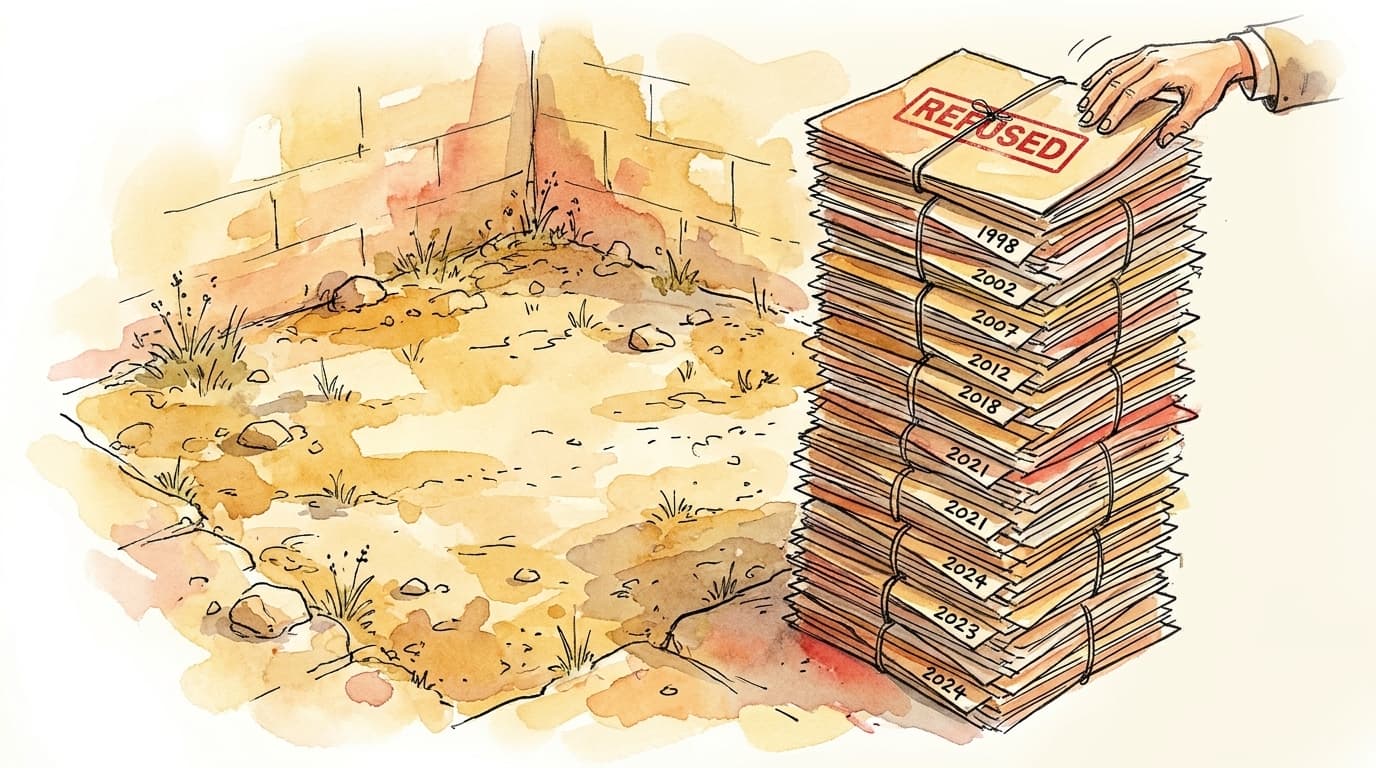
When a planning application is refused in Malta, applicants frequently try again at the same site. Of 23,571 refused cases that were followed by a new application at the same physical site, 74.5% were eventually approved. Some sites — predominantly Valletta restaurants and bars — have seen 40+ applications after an initial refusal. Refusal is less a verdict than a speed bump.
"Same site" here is determined from each case's mapped footprint, not from the address text — see the methodology section for details.
Key findings
What happens after refusal?
Of 23,571 refused PA cases where a new application was later filed at the same physical site:
| Outcome of next application | Count | % of decided |
|---|---|---|
| Approved | 15,877 | 74.5% |
| Refused again | 5,447 | 25.5% |
| Pending/other | 2,247 | — |
Three-quarters of refiled cases get approved. The system rewards persistence.
How quickly do people refile?
| Time to refile | Cases |
|---|---|
| Within 1 month | 788 |
| 1–3 months | 1,662 |
| 3–6 months | 2,075 |
| 6–12 months | 3,291 |
| 1–2 years | 4,099 |
| 2+ years | 11,656 |
788 cases were refiled within a month of refusal — barely enough time to revise plans. The largest group (11,656) waited over 2 years, possibly hoping for policy changes or new board members.
The most contested sites
The most contested sites — those with the most applications filed after at least one refusal — are dominated by Valletta restaurants, bars and small commercial properties cycling through repeated permit applications, plus a handful of high-profile development sites in Sliema, Gzira and St Julian's.
| Site | Applications after refusal |
|---|---|
| Tico-Tico, Triq Id-Dejqa, Valletta | 68 |
| Stores B & C, Triq il-Karrijiet, Valletta | 58 |
| Site at, Triq Marina, Marsalforn | 54 |
| Tigne House, Triq Bisazza, Sliema | 53 |
| Tal-Hwawar 15, Triq San Ġwann / Triq San Pawl, Valletta | 51 |
| Storie e Sapori, Triq ix-Xatt, Gzira | 51 |
| Wild Honey, 127 Triq Santa Luċija, Valletta | 48 |
| Tara's, St. Zachary's Street, Valletta | 47 |
| Area in front of 26 Triq Santa Luċija, Valletta | 47 |
| Vacant plot, Triq Elija Zammit / Triq Sant Andrija, St Julian's | 47 |
| That's Amore, 29 Triq il-Merkanti, Valletta | 45 |
| HSBC Head Office, 115/116 Triq L-Arcisqof / Triq ir-Repubblika, Valletta | 44 |
The dominant pattern is Valletta licensed-premises sites — bars, restaurants and small retail units inside the city walls — repeatedly applying for permit changes (table layouts, signage, structural sanctioning) over many years. Whatever the local context, each of these sites has seen 40+ separate applications enter the planning pipeline after at least one refusal.
The persistence cycle
Combined with other findings, the refiling data reveals a system where refusal is rarely the end:
- Application refused → 74.5% of refiles approved
- Deferred instead of refused → 90.8% eventually approved ("Deferred cases")
- Officer recommends refusal → board overrides 25% of the time ("Board vs officer")
The system offers multiple paths around "no": refile, appeal via deferral, or rely on the board to override its own officers.
Why this matters
A planning system's credibility depends on its ability to say no and mean it. When three-quarters of refused applications succeed on retry at the same site, the signal to developers is clear: keep trying. The sites with 40–70 applications after refusal represent decades of regulatory attrition — applicants wearing down resistance through sheer persistence.
Media sources
- "Activists decry Planning Authority's sanctioning of illegal buildings in defiance of court rulings" — MaltaToday, 31 August 2024. Documents the persistence of applicants and PA sanctioning despite earlier refusals or court orders — the same loop the story quantifies.
- "After 30 years of planning illegalities, UNO club owners want PA rubber stamp" — The Shift News, 4 September 2023. Concrete case of a single site repeatedly applying over decades, mirroring the contested-sites table in the story.
- "Prime Minister accused of allowing developers to undermine Malta's planning system" — The Shift News, 31 August 2024. Contextualises the developer-persistence pattern at policy level (Sannat case + Portelli permits revoked then reapplied).
Methodology
Each application in the database is mapped as a polygon. "Same site" here means two cases sit on the same patch of ground — their mapped footprints overlap on a ~40m grid. Joining on the address text alone is unreliable: many entries default to a road-level label ("Site at, Triq X, Town") that is reused across distinct buildings on the same street. An earlier draft of this story used that approach and credited "Site at, Triq Marsalforn, Xagħra" with 84 post-refusal applications; the footprint-based check shows that label actually covers more than 200 distinct cases spread along a kilometre of road, not one site.