The Pre-1967 loophole
Malta's get-out-of-planning card
Summary
Applications referencing "pre-1967" structures — buildings claimed to predate Malta's planning regulations — have surged from 5/year in the mid-2000s to 283/year in 2025. Their approval rate has simultaneously climbed from ~50% to 95%+. A third of these cases are in ODZ (Outside Development Zone) areas, making the pre-1967 claim a powerful tool for establishing a foothold in otherwise protected countryside.
Approval-rate trends use decided PA cases; pre-1967 identification uses keyword search of work descriptions. See methodology for limitations.
Key findings
The pre-1967 explosion
| Year | Pre-1967 cases | Approval rate |
|---|---|---|
| 2005 | 4 | 25% |
| 2010 | 18 | 33% |
| 2014 | 28 | 96.4% |
| 2016 | 88 | 81% |
| 2017 | 100 | 83% |
| 2018 | 139 | 93.6% |
| 2020 | 163 | 94.1% |
| 2022 | 200 | 96.7% |
| 2024 | 267 | 94.4% |
| 2025 | 283 | 98.8% |
From virtually zero to nearly 300 cases per year, with approval rates approaching 99%. The system has gone from sceptical of pre-1967 claims to near-automatic acceptance.
How the loophole works
Malta introduced planning regulations in 1967. Structures built before that date occupy a special legal status — they predate the regulatory framework and can be recognised, then extended or altered. The database shows three main uses:
| Work type | Cases | Approval rate |
|---|---|---|
| Sanctioning pre-1967 structures | 661 | 86.8% |
| Extensions to pre-1967 buildings | 540 | 96.0% |
| Alterations to pre-1967 buildings | 253 | 97.5% |
| Demolition of pre-1967 buildings | 154 | 90.4% |
| Restoration of pre-1967 buildings | 108 | 92.5% |
The pattern: first, get a pre-1967 structure officially recognised (sanctioning). Then extend or alter it — at which point the approval rate climbs to 96–97%.
What are these structures?
Each pre-1967 case is bucketed by priority on its work description (dwellings → rooms → stores → garages → walls → farm). See the SQL below.
| Type | Cases |
|---|---|
| Dwellings | 698 |
| Rooms | 450 |
| Stores | 224 |
| Garages | 102 |
| Walls | 97 |
| Farm/agricultural | 13 |
| Other | 450 |
A third are in ODZ
Of pre-1967 cases that went to board hearings:
| Commission type | Cases |
|---|---|
| WDS (within development zone) | 273 |
| ODZ (outside development zone) | 195 |
| Other/unknown | 73 |
| BOARD | 3 |
36% of pre-1967 cases heard by commissions are in ODZ areas (195 of 544). This is significant: normally, building in the countryside faces strict restrictions. But claiming a pre-1967 structure exists on the land effectively bypasses ODZ protections, allowing sanctioning, extensions, and alterations in otherwise protected areas.
The mechanism
- Claim a structure on your land was built before 1967
- Apply to "sanction" it (86.8% approval)
- Once sanctioned, apply to extend or alter it (96–97% approval)
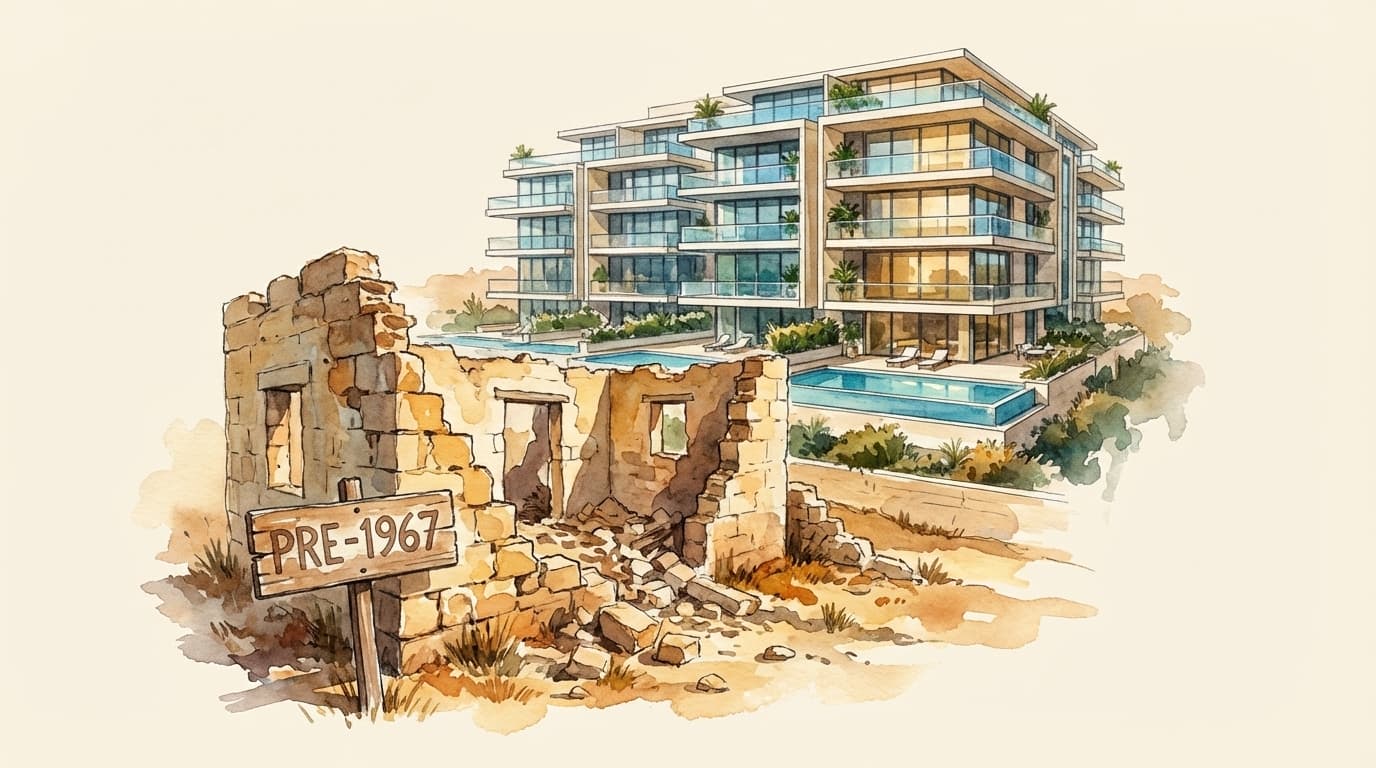
- The pre-1967 structure — which may have been a simple rubble room or store — becomes the legal foundation for a much larger development
In ODZ areas, this is particularly powerful because it provides a legitimate basis for development that would otherwise be refused.
Notable cases
PA/04981/25 — Pre-1967 Agricultural Store, Lija (ODZ). An application to sanction the "upgrading" of pre-1967 agricultural stores in the countryside. The case officer recommended refusal, but the board approved it in February 2026. The classic loophole pattern: a claimed pre-1967 structure used to legitimise development outside the development zone, with the officer overruled.
PA/04392/25 — Triq it-Torri tal-Ghallis, Magħtab, Naxxar (ODZ). Sanctioning of agricultural stores "constructed in lieu of pre-1967 agricultural stores (same area)." The original pre-1967 structures were demolished and replaced with new ones — then retroactively legalised. Officer recommended refusal; board approved in December 2025. This case illustrates the most aggressive use of the loophole: demolish the old structure, build something new, then claim the pre-1967 lineage.
PA/04305/25 — Ta' Srajmiet, Siġġiewi (ODZ). Restoration of a pre-1967 structure with "replacement of dangerous roofs and addition at first floor level." What begins as a restoration ends as vertical expansion — a first floor added to what was likely a simple rural room. Approved December 2025. The step-by-step escalation from sanctioning to extension is the mechanism that turns rubble walls into residences.
Why this matters
The pre-1967 threshold is now nearly 60 years old, yet the number of applications citing it is increasing, not decreasing. If anything, one would expect fewer genuine pre-1967 structures to remain unrecognised after decades. The surge suggests either a growing awareness of the loophole, a relaxation in how claims are verified, or both. Combined with a 95%+ approval rate, the pre-1967 designation has become one of the most reliable paths to planning permission — especially in the countryside.
Going forward, the loophole will only grow more problematic. Every year that passes makes it harder to verify whether a structure genuinely predates 1967 — aerial photography from that era is limited, and physical evidence degrades. Without a verification reform (independent surveys, historical evidence requirements, or a sunset clause), the system is increasingly reliant on applicants' self-certification of a claim that is nearly impossible to disprove.
The connection to ODZ protections ("The ODZ foot in the door") is particularly concerning. Malta's development zone boundaries are its primary tool for protecting countryside and agricultural land. If a pre-1967 claim can bypass those boundaries — and the data shows a third of pre-1967 cases are in ODZ — then the policy effectively has a back door. Closing it would require either raising the evidentiary bar for pre-1967 claims in ODZ areas or imposing strict limits on what can be done with a sanctioned pre-1967 structure (no extensions, no change of use).
International context
England's closest equivalent to the pre-1967 loophole is the "lawful development certificate" for structures that have existed for four years (or ten years for changes of use) without enforcement action. Crucially, the English system requires the applicant to provide evidence — sworn statements, utility bills, aerial photos — and the burden of proof rests with the applicant, not the authority. Even then, a lawful development certificate only legalises what exists; it does not create a right to extend, alter, or rebuild. Malta's system, by contrast, not only accepts pre-1967 claims with minimal verification but then allows approved extensions at a 96% rate — effectively turning a historical status into a development right.
Media sources
- "Planning Authority set to lose magic wand that turns ruins into villas" — MaltaToday, 1 July 2020. Confirms the pre-1967 threshold change from the 2014 policy (which used 1978), and describes how ruins were converted into villas with pools using notarial declarations — corroborating the sanctioning-then-extension mechanism.
- "MEPA's rural policy turns rubble into new homes" — MaltaToday, 24 February 2016. Documents a case where a collapsed farmhouse with nothing remaining on site was approved for reconstruction as a dwelling, illustrating how the pre-1967 claim enables development from rubble.
- "Over 600 ODZ developments approved in 2019 and 2020" — Malta Independent, 12 January 2021. Parliamentary data confirms hundreds of ODZ applications approved against officer recommendation, corroborating that pre-1967 claims in ODZ areas face minimal resistance.
- "Tribunal overturns PA decision, grants permit for Dwejra boathouse extension" — Times of Malta, 30 September 2024. A pre-1967 boathouse in Dwejra was sanctioned in 2017, then further extended and sanctioned again on appeal -- illustrating the mechanism of using pre-1967 status to establish a footprint and then incrementally expand it.