The great erasure
Four to five demolitions approved every day
Summary
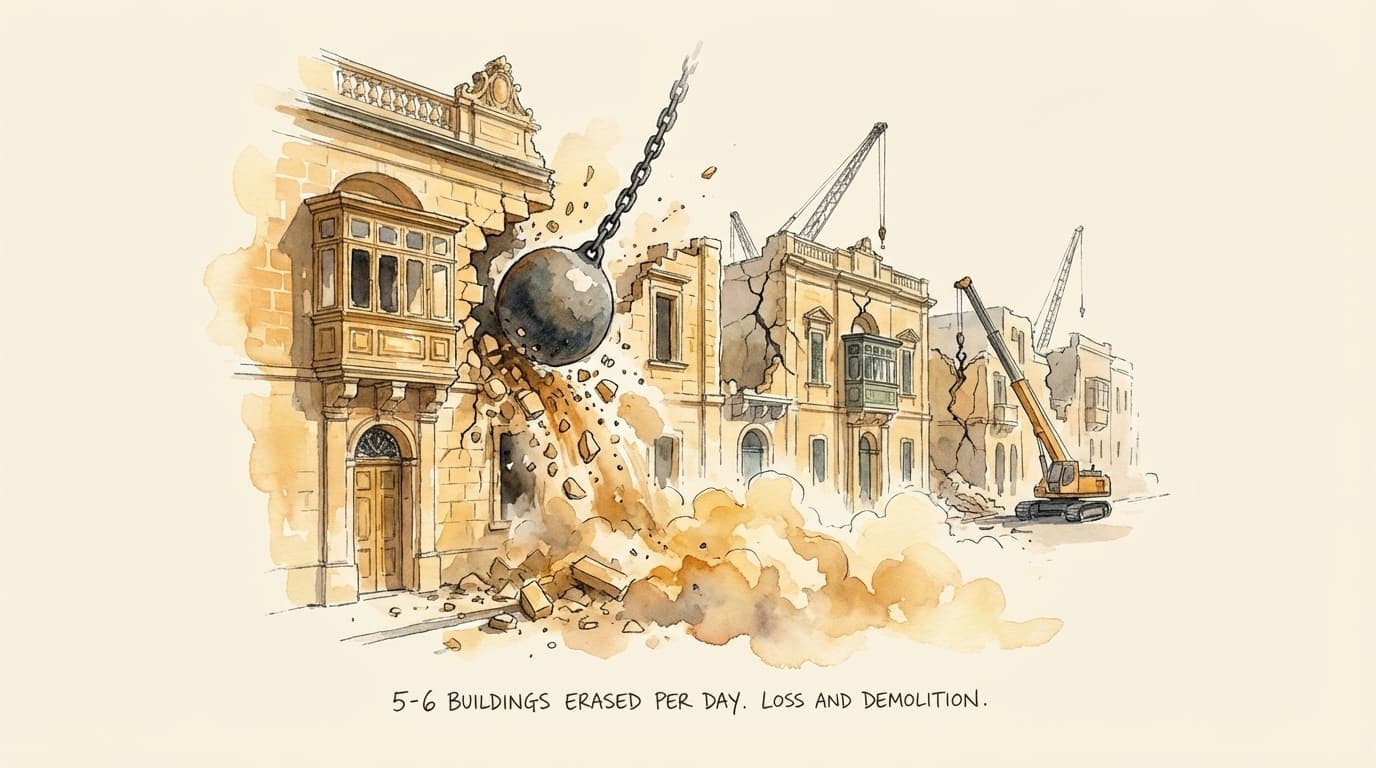
44,396 demolition applications approved — four to five every single day, for over a decade. Malta isn't just building — it's erasing itself.
A villa by the sea
PA/00379/00 — Villa Louise, Ix-Xatt, Sliema. A seafront villa demolished and replaced with an apartment block containing 14 apartments, a penthouse, commercial space, and semi-basement parking. This early case from 2000 foreshadowed the pattern that would accelerate over the next two decades: the systematic replacement of Sliema's period villas with high-density residential blocks.
Villa Louise stood on Sliema's seafront. It was demolished and replaced with 14 apartments, a penthouse, and commercial space. In 2000, this felt like an isolated loss.
It was the beginning of a pattern.
The numbers behind the loss
The planning database contains 51,782 demolition-related cases — PA applications mentioning demolition plus dedicated DN (Demolition Notification) cases. PA demolition applications rose from 246 in 2000 to 1,515 in 2018 — a six-fold increase.
That's a lot of buildings. But to understand the true scale, you need to see the rate.
Five buildings a day
When PA demolitions are combined with DN (Demolition Notification) cases — a fast-track channel introduced around 2002 — the total has remained above 2,000 every year since 2013. Of these, 44,396 were approved — roughly four to five demolition approvals every single day across one of Europe's smallest countries.
Demolition applications over time
| Year | PA demolition apps | DN notifications | Combined total |
|---|---|---|---|
| 2000 | 246 | 0 | 246 |
| 2001 | 224 | 0 | 224 |
| 2002 | 284 | 2,672 | 2,956 |
| 2003 | 362 | 1,010 | 1,372 |
| 2004 | 441 | 924 | 1,365 |
| 2005 | 467 | 889 | 1,356 |
| 2006 | 560 | 875 | 1,435 |
| 2007 | 487 | 1,054 | 1,541 |
| 2008 | 355 | 1,354 | 1,709 |
| 2009 | 329 | 1,195 | 1,524 |
| 2010 | 344 | 1,294 | 1,638 |
| 2011 | 210 | 1,427 | 1,637 |
| 2012 | 236 | 1,695 | 1,931 |
| 2013 | 266 | 1,807 | 2,073 |
| 2014 | 364 | 2,069 | 2,433 |
| 2015 | 687 | 2,548 | 3,235 ← peak |
| 2016 | 926 | 1,609 | 2,535 |
| 2017 | 1,222 | 1,165 | 2,387 |
| 2018 | 1,515 | 1,398 | 2,913 |
| 2019 | 1,209 | 1,412 | 2,621 |
| 2020 | 900 | 1,200 | 2,100 |
| 2021 | 924 | 1,382 | 2,306 |
| 2022 | 887 | 1,212 | 2,099 |
| 2023 | 985 | 1,162 | 2,147 |
| 2024 | 1,013 | 1,264 | 2,277 |
| 2025 | 1,117 | 1,302 | 2,419 |
Two things stand out. First, the DN system created a fast-track channel for demolitions that operates alongside the traditional PA process. Second, the PA demolition count itself surged dramatically from the mid-2010s: the 2018 count of 1,515 is six times the 2000 level of 246. Even after a COVID dip, numbers remain elevated at over 1,000 PA demolitions per year.
But the daily rate only tells part of the story. The question is: where is the damage concentrated?
Where it hurts most
| Locality | Demolition cases |
|---|---|
| Sliema | 1,571 |
| Birkirkara | 1,372 |
| Mosta | 1,153 |
| Qormi | 1,047 |
| San Ġiljan | 973 |
| Naxxar | 944 |
| San Pawl il-Baħar | 912 |
| Żabbar | 871 |
| Marsaskala | 846 |
| Mellieħa | 834 |
| Attard | 833 |
| Żejtun | 777 |
| Birżebbuġa | 691 |
Sliema leads Malta's demolition count at 1,571 cases — the systematic replacement of its townhouse streetscapes with apartment blocks. Birkirkara, Mosta, and Qormi follow, representing the hollowing out of Malta's traditional inland towns. San Ġiljan, already identified as the hotel invasion epicentre ("The hotel invasion"), ranks 5th with 973 demolitions.
The pattern is the same everywhere: townhouses, family homes, period buildings — replaced by apartment blocks, garages, and commercial developments. And once a demolition is filed, the outcome is almost certain.
The approval machine
Of demolition-related cases that received a decision, 18,951 were approved through the DN system, 12,423 received Grant Permission through PA, and only 1,969 were refused through DN and 1,155 through PA. The combined approval rate across both tracks exceeds 90%.
Once a demolition is filed, it is almost certain to proceed. There is no effective mechanism for saying "this building should remain."
What Sliema looks like now
PA/04960/25 — 27, 30 & 31 Triq Viani, Sliema. Three properties — two townhouses and a maisonette — approved for demolition and replacement with a six-storey apartment block including shops, a church store, and two rooftop pools. Triq Viani alone has seen dozens of similar conversions, making it a microcosm of Sliema's transformation from a town of family homes into a wall of apartment blocks.
PA/06132/24 — 151/152 Triq Rodolfu, Sliema. Two adjacent townhouses approved for demolition — though the facades are to be "retained" — and replacement with 12 apartments and a shop. Facade retention has become a recurring pattern: the streetscape is preserved as a thin decorative shell while the building behind it is entirely replaced.
Why this matters
Every number in this dataset represents a building that existed — a townhouse, a farmhouse, a shop, a family home — and was replaced by something else, almost always larger. At a combined rate of over 2,000 demolition cases per year, Malta is erasing roughly 5–6 buildings every single day. For one of Europe's smallest and most densely populated countries, with a built heritage stretching back millennia, this rate of physical erasure is extraordinary. The data does not tell us what was lost — only that it is gone.
The trend shows no sign of reversing. Even after a COVID-era dip, demolition rates have returned to over 2,000 per year. With the DN fast-track system processing demolitions with minimal scrutiny and the PA route approving over 90%, there is no effective mechanism for saying "this building should remain." The question facing Malta is whether anything in its current planning framework can halt the replacement cycle before the traditional urban fabric that gives towns like Sliema, Birkirkara, and Mosta their character is entirely gone. The connection to "Build first, ask later" (Build First, Ask Later) is direct: many of the buildings replacing demolished ones are themselves later sanctioned for deviations from approved plans, creating a double erosion of planning control.
International context
In England, demolition within conservation areas requires specific consent, and roughly 15% of such applications are refused — a meaningful check on the erasure of historic streetscapes. Listed buildings receive even stronger protection, with separate listed building consent required for any alteration or demolition. Malta's combined demolition approval rate of over 90% across both PA and DN tracks, even in historically sensitive localities like Sliema and Valletta, suggests that the planning system provides significantly weaker protection for the existing built environment than comparable European jurisdictions.
Media sources
- "Townhouses outside urban conservation areas are quick to fall in developers' grip" — MaltaToday, 23 May 2016. Documents the systematic demolition of characteristic townhouses in Sliema and St Julian's to build apartment blocks, with a "summary procedure" reducing scrutiny for projects of up to 16 units.
- "NGO highlights 'onslaught on heritage in the very heart of Sliema'" — Malta Independent, 30 July 2019. Din l-Art Helwa opposes demolition of a 70-metre row of early 20th-century houses on Depiro Street for a six-storey apartment block, warning "there will soon be nothing to show of our vernacular town houses."
- "Malta risks losing historical and artistic patrimony, warns Chamber of Architects" — MaltaToday, 19 April 2020. The Kamra tal-Periti warns that indiscriminate demolition is "resulting in a general impoverishment of our urban areas," referencing a joint declaration by 22 heritage organisations.
- "Malta's unique built heritage being 'lost at alarming rate'" — Times of Malta, 23 February 2018. The president of the Chamber of Architects expressed serious concern about the "alarming rate" at which Malta's built heritage was being lost to new development, questioning planning policies that allow full-scale demolition.
- "House of 'evident cultural heritage value' torn down in St Julian's" — Times of Malta, 29 April 2023. A historic townhouse was demolished and replaced with apartments despite the Superintendence of Cultural Heritage not being consulted and opposing the demolition, corroborating the systematic erasure of heritage buildings.