When God moves out
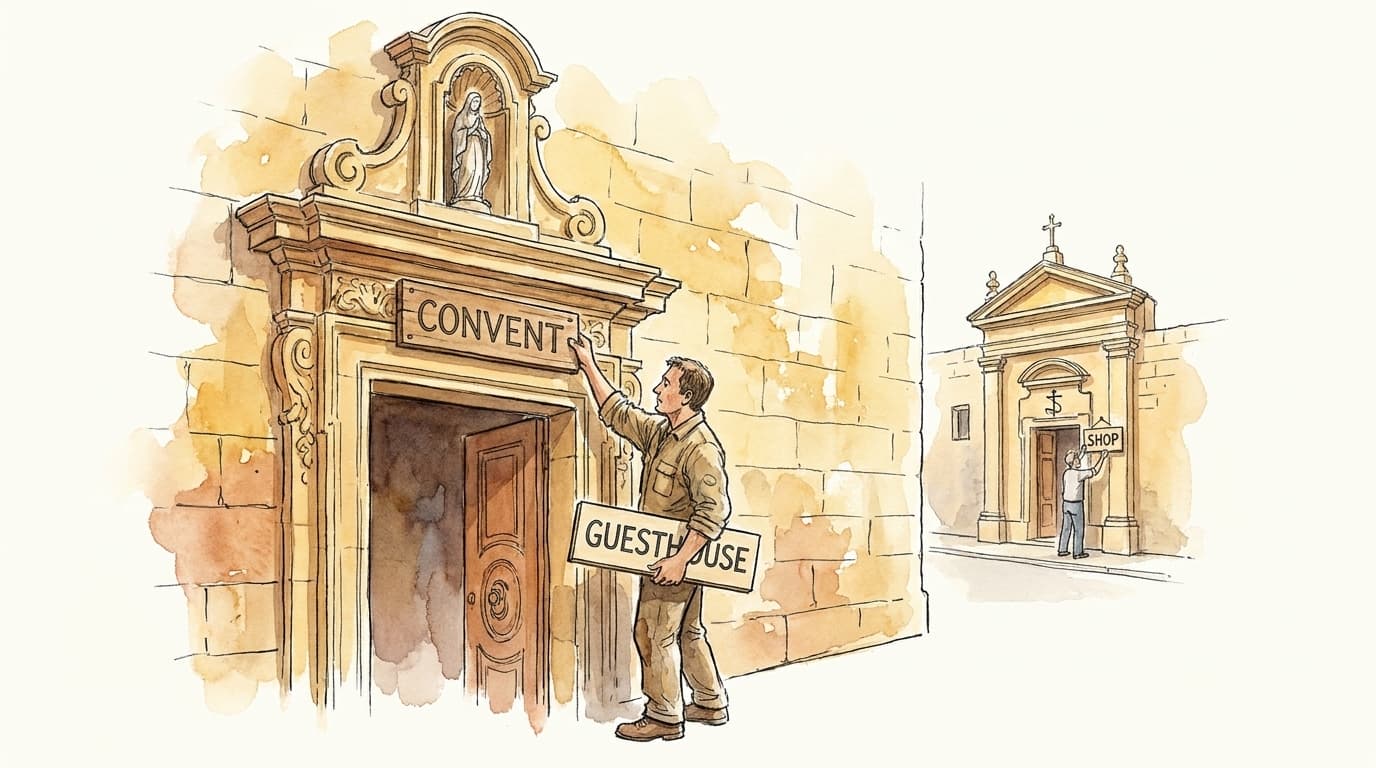
Convents into guesthouses, chapels into shops
Summary
Across Malta and Gozo, religious buildings — convents, churches, chapels, and monastery annexes — are being converted into nursing homes, student accommodation, guesthouses, and retail spaces. The planning database records 674 applications mentioning religious buildings (186 convents, 300 churches, 201 chapels, 2 monasteries), many involving change-of-use proposals that repurpose these once-sacred spaces for commercial gain.
The trend tells a story of secularisation meeting speculation: as religious orders shrink and vocations dry up, their properties — often large, centrally located, and architecturally distinctive — become irresistible development targets.
Key findings
Documented conversions of religious buildings
| Case | Description | Location | Decision |
|---|---|---|---|
| PA/04293/25 | Convent → Class 2A nursing home (23 rooms), with additional level and pool | Sisters of Charity Convent, Birżebbuġa | Pending |
| PA/04910/21 | Disused convent → student accommodation (Class 3A) | 49 Triq Santa Monika, Gwardamanġa, Pietà | Approved |
| PA/02020/20 | Former chapel → retail (Class 4B) with crafts workshop (Class 5A) | 19 St. Francis, Triq Lord Byron, Ħamrun | Approved |
| PA/00970/25 | Church school → childcare centre (Class 2C) | ex-St. Francis School, Luqa | Withdrawn |
| PA/01071/23 | Convent → Class 3A guest house (17 rooms) | Ursuline Institute, Cospicua (Bormla) | Approved |
| PA/08425/20 | Vacant residence (Villa Buleben) → Class 3B hotel, 3-storey extension | Villa Buleben, near church lands | Approved |
| PA/07734/21 | St Joan Antide Convent → residential rehabilitation with extension | 8 Triq tal-Hofra, Gudja | Approved |
| PA/00655/26 | Chapel at first floor → Class 4A offices | 63 Triq San Girgor, Żejtun | Suspended (at perit's request) |
The pattern is consistent: religious orders or their successors apply to convert surplus property, and the Planning Authority overwhelmingly approves. Of the known conversion cases above, none have been refused.
The scale of religious property in the planning system
The database contains 674 PA applications mentioning religious building types in their descriptions:
| Building type | Applications |
|---|---|
| Church | 300 |
| Chapel | 201 |
| Convent | 186 |
| Monastery | 2 |
Not all of these are conversions — many involve restoration, maintenance, or extensions. But the subset that involves change of use reveals a clear pattern: properties are moving from religious use to commercial accommodation (hotels, guesthouses, student housing) and care facilities (nursing homes, childcare centres). The Ursuline Institute in Cospicua (PA/01071/23), converted into a 17-room guesthouse, is emblematic — a religious order's educational mission replaced by short-let tourism.
Who benefits?
The applicants range from religious orders themselves (Rev Anton Galea Scannura, Fr Richard Nazzareno Farrugia) to commercial operators (Short Lets Malta, Convent Care Limited). In several cases, the religious order is the applicant — suggesting these conversions are sometimes driven by the orders' own financial pressures rather than external developers.
Why this matters
Malta is one of the most Catholic countries in Europe — over 80% of the population identifies as Catholic. The conversion of convents, chapels, and church schools into commercial properties is not merely a planning story; it is a cultural transformation captured in permit applications. Each conversion represents the physical retreat of the Church from Malta's daily life. When a convent becomes a guesthouse and a chapel becomes a shop, the change is not just functional — it rewrites the character of streets and communities that were shaped around these institutions for centuries.
Media sources
- "PA approves conversion of historic Ursuline convent into boutique hotel" — Newsbook. Directly corroborates the PA/01071/23 Ursuline Cospicua case cited in the story.
- "Post-War Bormla Convent To Be Converted Into Boutique Guest House, PA Announces" — Lovin Malta. Independent confirmation of the same Ursuline Cospicua case.