The Dingli stand
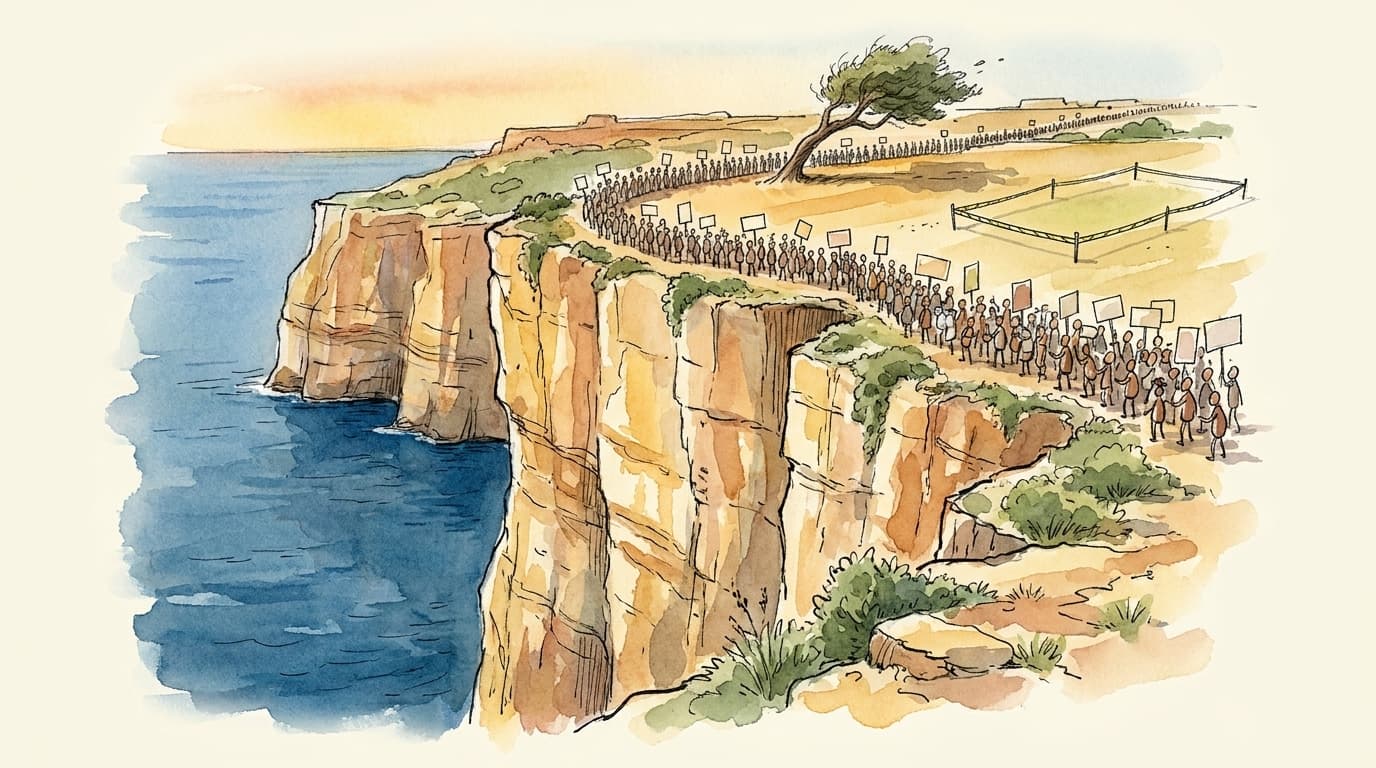
When four hundred voices won
Summary
In 2020, an application was filed to reconstruct "pre-1978 habitable rooms" at a site called Angel's Leap, perched on the cliffs along Triq Panoramika near Dingli — one of Malta's last stretches of unspoiled coastal landscape and a Natura 2000 protected area. The case, PA/04519/20, became a flashpoint: it drew hundreds of objections, galvanised environmental campaigners, and was ultimately refused by the Planning Authority. It is one of the rare cases where public opposition actually stopped a development.
But the Dingli cliffs remain under relentless pressure. The database reveals a steady stream of applications along Triq Panoramika and Triq l-Irdum — the roads that trace the cliff edge — including agricultural stores, bungalows, dwelling reconstructions, and even an olive oil production facility in a former fireworks factory.
Hearing and objection counts are drawn from 69,254 board minute entries. See methodology for coverage details.
Key findings
PA/04519/20 — Angel's Leap
| Field | Detail |
|---|---|
| Case number | PA/04519/20 |
| Description | Proposed re-construction of pre-1978 habitable rooms |
| Location | Angel's Leap, Ta' Zuta, off Triq Panoramika, Siġġiewi |
| Applicant | Ms Dolores Gatt |
| Architect | Perit Joseph Bondin |
| Filed | 9 June 2020 |
| Category | Outside Development Zone |
| Decision | Refuse Permission |
| Decision date | 28 August 2025 |
The application sought to reconstruct rooms at a site in one of Malta's most environmentally sensitive locations. The site sits within the Natura 2000 network — the EU's cornerstone of nature protection. The five-year gap between filing (June 2020) and refusal (August 2025) reflects the intensity of the dispute. The wider Dingli cliffs campaign — including the high-profile Pulvich explosives-factory tourism proposal — attracted over 400 public objections and rare board defeats, building the political pressure that delivered the Angel's Leap refusal.
Development pressure along the cliffs
The database reveals ongoing development activity along the Dingli cliff roads:
| Case | Year | Description | Location | Decision |
|---|---|---|---|---|
| PA/00123/25 | 2024 | Demolition of existing structure, excavation of reservoir and two-storey basement, construction | Seacliff, Triq l-Irdum, Dingli | Approved |
| PA/01188/25 | 2025 | Minor alterations including split of duplex into two units | 27 Komarovsky Aparts, Triq l-Irdum, Dingli | Approved |
| PA/07689/25 | 2025 | Sanctioning of changes to terraced house and garage | 113 Triq l-Irdum, Dingli | Pending |
| PA/07586/25 | 2025 | Underground reservoir and timber gate | Agricultural field, Triq Panoramika, Dingli | Approved (decision since story snapshot) |
| PA/05589/25 | 2025 | Sanctioning of open storage yard for geological testing equipment | Tal Pitkali, Triq Panoramika, Dingli | Pending |
| PA/07438/24 | 2024 | Conversion of disused fireworks factory to olive oil production | Triq Panoramika, Dingli | Pending |
| PA/04851/25 | 2025 | To sanction agricultural room and propose widening of site access | Trejqet l-Irdumijiet, Dingli | Approved |
The pattern is familiar: a mix of sanctioning (legalising already-built structures), agricultural buildings that establish a foothold, and residential applications that push habitation further along the cliffs. The conversion of a fireworks factory to an olive oil facility (PA/07438/24) shows how industrial-to-commercial conversion creeps into even the most protected landscapes.
Dingli development trend
| Year | PA applications in Dingli |
|---|---|
| 2015 | 78 |
| 2016 | 129 |
| 2017 | 144 |
| 2018 | 151 |
| 2019 | 118 |
| 2020 | 121 |
| 2021 | 123 |
| 2022 | 114 |
| 2023 | 111 |
| 2024 | 103 |
| 2025 | 103 |
Applications in Dingli nearly doubled between 2015 and 2018, and while they have declined slightly since, they remain well above the pre-boom baseline. For a small, predominantly rural locality, over 100 planning applications per year represents significant development pressure.
Why this matters
PA/04519/20 is important not because it was refused — but because refusal is so rare. Across the entire planning database, the board overwhelmingly approves (see "Board vs officer"). The Angel's Leap case required 400+ objections, years of campaigning, and a Natura 2000 designation to achieve what should be a straightforward outcome: refusing development on a cliff edge. Meanwhile, the steady accumulation of "minor" applications — agricultural stores, sanctioning of existing structures, reservoir excavations — continues to erode the landscape through a thousand small cuts that never attract the same public attention.
Media sources
- "Planning Authority flooded with objections over Dingli Cliffs development" — The Shift News, 26 April 2021. Documents the 400+ objections to a Dingli ODZ tourism development that established the precedent the story analyses.
- "REFUSED: Dingli explosives factory development application turned down" — The Shift News, 18 November 2021. Contextual corroboration of the Dingli-cliffs refusal precedent.
- "Dingli Cliffs hotel set for refusal after PA board postpones decision" — MaltaToday. Confirms NGO/Council pressure pattern on Dingli ODZ proposals.