Fort Chambray
From Knights' fortress to luxury apartments
Summary
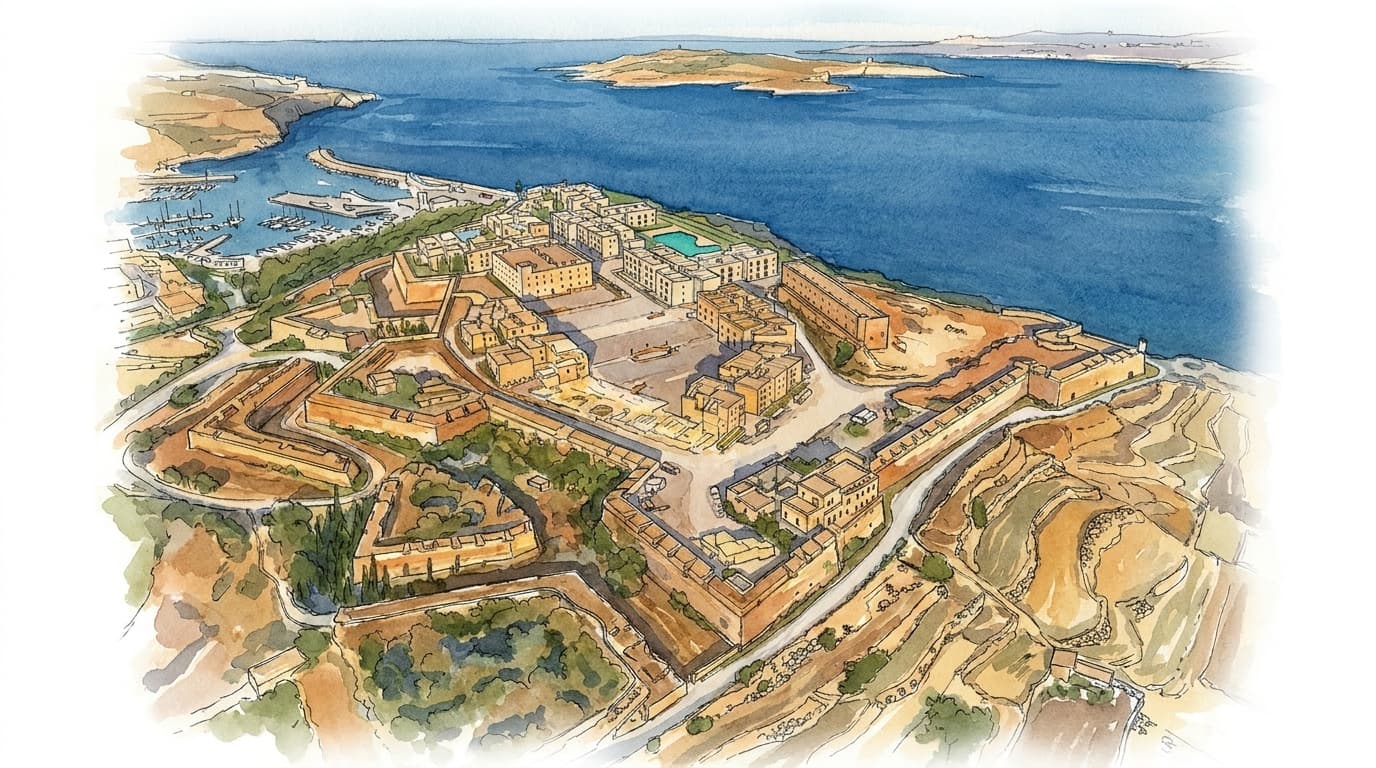
A fortification built by the Knights of St John in 1749 to defend Gozo has been systematically converted into a private residential and hotel complex over 33 years. The planning database contains 83 applications for Fort Chambray — documenting one of Malta's most complete case studies of heritage fortification privatisation, from the original 1993 outline permission for 236 residential units through to the 2024 approval of a 5-star aparthotel with 105 luxury apartments.
Key findings
- PA/02884/93 granted outline permission in December 1993 for a massive mixed development: 236 residential units, a 300-bed 4/5-star hotel, commercial centre, health & fitness facilities, and 708 car parking spaces — all inside an 18th-century fortress
- The applicant, Fort Chambray Ltd, has driven the project through three decades and multiple phases, with Dr. Michael Caruana as the recurring named applicant
- Of 83 total applications, 37 received "Grant Permission" and 15 received "Approved" (with a further 7 across "Acceptable", "Accepted" and DNO/Sanita variants) — an overall positive decision rate of 83% across 71 decided cases, with only 7 refusals (~10% of decided cases)
- The most recent major approval, PA/03884/23 (granted December 2024), adds a 64-room 5-star aparthotel, 50 serviced apartments, and 105 residential units in Phase 3
- PA/02454/16 approved the dismantling of the British Barracks to make way for Phase 3 — the physical erasure of one heritage layer to enable a commercial layer
The 33-year timeline
| Period | Key applications | What happened |
|---|---|---|
| 1993 | PA/02884/93 | Original outline permission: 236 units, hotel, commercial |
| 1995–2000 | PA/06415/97 | Knight's Barracks alterations |
| 2000–2007 | PA/03883/00 | Proposed 400-bed hotel (later withdrawn) |
| 2007–2015 | Multiple | Road access, residential modifications, sanctioning |
| 2021–2024 | PA/02454/16, PA/03884/23 | British Barracks dismantling approved (Dec 2024); Phase 3 aparthotel + 105 luxury residential units approved (Dec 2024) |
| 2025–2026 | DN/00170/26 | Continued property sanctioning |
What's being built inside a Knights' fortress
The descriptions reveal the transformation: swimming pools, garages, penthouses, youth hostels, elderly care facilities, football pitches, art schools, and a parish centre — an entire town growing inside fortification walls. Units are marketed as Special Designated Area properties, allowing foreign buyers to purchase without restriction, with prices ranging from €174,000 to over €1 million.
Why this matters
Fort Chambray is arguably Malta's most complete example of fortress-to-residential conversion. The 83 planning applications document a three-decade process in which a military fortification — built to protect an island population — was incrementally transformed into a gated luxury development marketed to international buyers. The 83% approval rate suggests the planning system has functioned less as a heritage gatekeeper and more as a facilitator of this conversion. The December 2024 decision to approve the dismantling of the British Barracks (PA/02454/16, filed in 2013) is particularly striking: one layer of military heritage was physically removed to make way for a hotel.
Media sources
- "Fort Chambray barracks listed among Europe's most endangered heritage sites" — The Shift News, 26 February 2026. Corroborates the heritage-loss narrative; Europa Nostra listing.
- "Approved: Gozo's Fort Chambray Barracks Will Be Demolished Ahead Of Aparthotel Development" — Lovin Malta. Corroborates the demolition and aparthotel cases cited in the story.
- "Mega developers set their sights on Gozo's Fort Chambray" — The Shift News, 21 October 2023. Documents the developer consortium acquiring the concession.
- "Fort Chambray: A Bad Deal For Malta" — Amphora Media, March 2025. Investigative critique of the concession terms.