Fort Ricasoli
Gladiator's fort
Summary
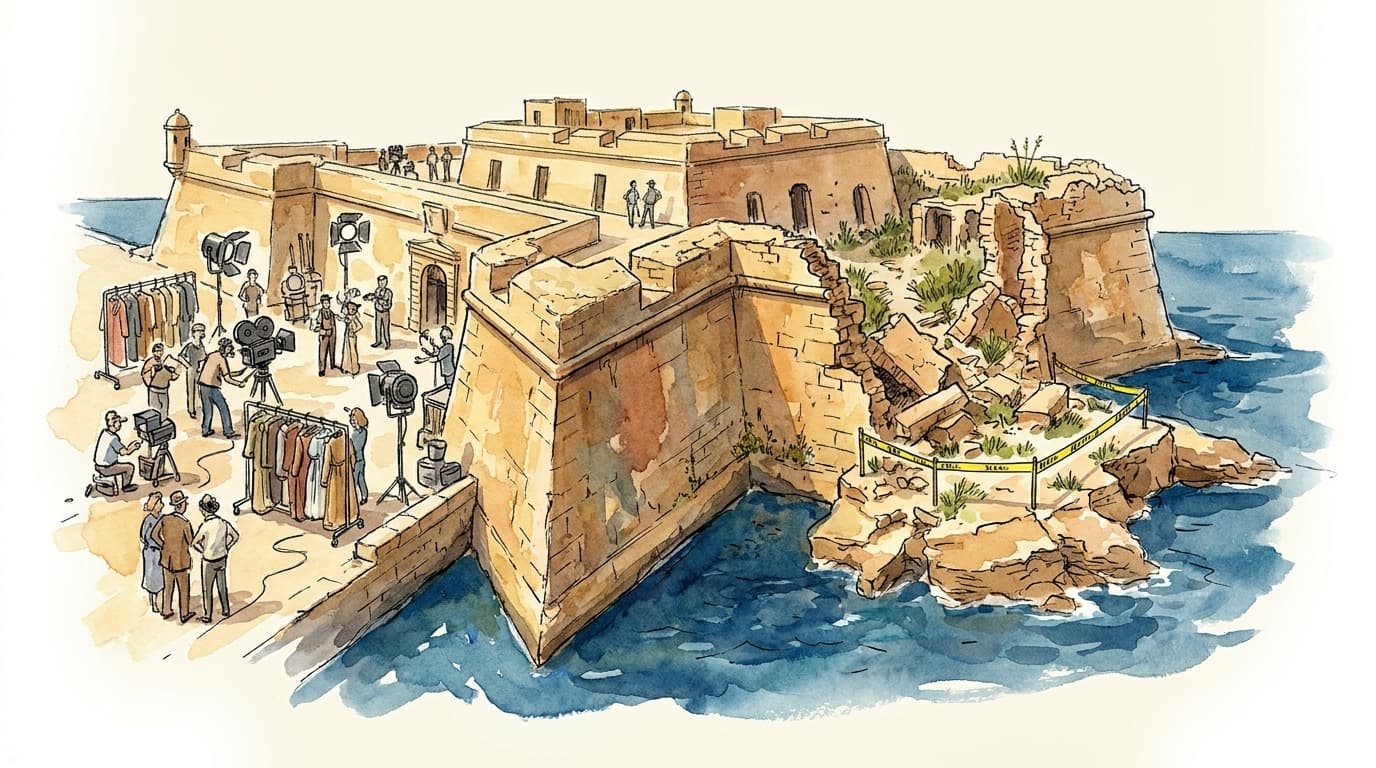
Fort Ricasoli, the massive 17th-century fortification guarding the eastern side of the Grand Harbour, has 161 planning applications in the database — documenting its transformation from derelict military site to Malta's premier film location and, more recently, the site of Smart City Malta. The fort where Gladiator, Troy, Napoleon, and Assassin's Creed were filmed has been simultaneously celebrated as a cinematic asset and criticised as a development opportunity disguised as heritage. Despite being one of the largest fortifications in Europe, the fort remains largely dilapidated outside the film production areas.
Key findings
- 161 planning cases reference Fort Ricasoli or the immediately adjacent area in Kalkara
- The cases split into three distinct streams: film production permits (temporary sets, sand placement, structures), Smart City Malta development (residential towers, commercial plots, hospital), and residential property modifications in surrounding areas
- Film permits are overwhelmingly approved — the database shows near-universal "Grant Permission" or "Approved" decisions for production companies including Taodue srl, Latina Pictures, and Pellikola Limited
- Smart City Malta development at the adjacent former industrial estate produced a cluster of applications from 2017 onwards for multi-plot residential and commercial buildings
The fort's three lives
| Era | Use | Key applications |
|---|---|---|
| Pre-2000 | Derelict military/industrial | Minimal planning activity |
| 2000–2019 | Film production site | DN/00877/19 (sand for filming), DN/01123/19 (temporary set), DN/01404/19 (temporary set), multiple production permits |
| 2017–present | Smart City Malta + filming | PA/03003/17 onwards: Smart City plots 3, 4, 9, 10; hospital site; residential towers |
Film production at a heritage site
The fort has hosted some of the biggest film productions to use Malta as a location: Gladiator (2000), Troy (2004), Agora (2009), Assassin's Creed (2016), and Napoleon (2023). The planning database captures the physical impact: temporary sets erected and removed, sand deposited and cleared, structures built for camera angles. These permits are processed through the DN (Development Notification) fast-track — approved quickly with minimal heritage scrutiny.
Smart City Malta: development at the gates
The Smart City Malta development — on the former industrial estate adjacent to Fort Ricasoli, demolished in 2007 — has produced a cluster of applications for modern residential and commercial buildings. The planning database shows applications for multiple numbered plots (3, 4, 9, 10, RT4), a hospital site, and promenade/public realm works (Laguna – City Park). These modern developments sit directly alongside the crumbling fortification walls.
The fort itself: still waiting
What the database does not show is as revealing as what it does. Despite restoration plans approved in July 2019 (PA/01599/14, "Modified as per Article 80"), the fort itself has minimal restoration activity in the planning record. The applications cluster around the periphery — filming permits, adjacent development, infrastructure — while the core fortification fabric appears largely untouched in the planning system. Fort Ricasoli remains one of Malta's largest and most significant fortifications, yet its planning footprint suggests it is valued more as a backdrop than as heritage.
Why this matters
Fort Ricasoli embodies the tension in Malta's approach to military heritage. It is simultaneously a protected scheduled monument and a revenue-generating asset — for film production, for adjacent property development, and potentially for future large-scale conversion. The 161 planning cases show activity around the fort rather than for it. Film sets come and go; Smart City rises next door; the fortification walls themselves continue to deteriorate. The planning data suggests that Malta's most economically productive use of this fortress has been lending it as a film set — a lucrative but temporary use that requires no permanent investment in the heritage fabric itself.
Media sources
- "Ricasoli: The fort that is not so slowly being eaten up by the sea" — Malta Independent, 16 July 2018. Corroborates the "still waiting / dilapidated" framing and walls-eroded-by-sea claim.
- "Film Commission 'leasing' Fort Ricasoli as film set location without title" — The Shift News, 10 January 2025. Corroborates the "film set rather than heritage" critique.
- "Public invited to view Gladiator 2 film set at Fort Ricasoli" — TVM News. Confirms recent film use cited in the story.